Equity in Capital Improvement Planning Processes

This white paper was a collaboration between myself, as primary writer and researcher, and Matt Stitt and Mike Nadol as editors and contributors. It was created as part of PFM’s work in the Bloomberg Results for America City Budgeting for Equity and Recovery program in 2021. The fully designed PDF can be viewed here.

Why This Matters?

Capital budgets and improvement plans present exceptional opportunities for governments to drive equitable outcomes in municipalities, particularly when budgeting for recovery. The significant spending power authorized through capital budgets – multiple billions for some jurisdictions – can allow for increased, targeted spending on geographies that historically lacked investment from the public and private sectors. In addition, the job creation necessary to complete these projects offer workforce and economic development opportunities for residents and businesses. Because the Capital Improvement Plan (CIP) typically requires a multi-year plan and planning process, it provides a framework that can be adapted to equitable purposes rather than created from scratch. When taken together with the scale of funding available, the CIP presents a ready-made strategy for planning, implementing, and evaluating projects that achieve enduring equitable outcomes.

Introduction

Infrastructure is the fabric that enables community connection, economic opportunity, and civic life in the United States. Eighty percent of public spending on these vital projects (from roads and bridges to parks and recreation centers) is provided by state and local governments. Yet despite its importance to everything from commerce to public health, the national total deferred maintenance on infrastructure assets could be as high as $1 trillion.[1]

Additionally, most cities have no structured mechanisms to incorporate equity considerations into their capital investment planning. Equity-based approaches to funding, project selection, and community input are still evolving and imperfect at best – but such approaches are now developing rapidly for operating budget allocations. To next integrate equity into longer-term financial strategies, Finance Directors, City Managers, and senior Elected Officials must all double-down on their efforts, sharpening their focus on capital investment planning. While there is no single solution that works for most cities – when it comes to matters of equitable impact, the best option is one that is place-based and reflective of the needs of a specific community. Ultimately, the process for equitable capital budgeting must be developed collaboratively and implemented through a thoughtful change management strategy.

This resource outlines a few strategies and case examples (related to equity in capital planning), from across the country, that can be adapted to the local context.

Using Capital Improvement Planning (CIP) Process to Drive Equitable Outcomes

To approach the CIP process in a manner that creates consistent, measurable, equity-focused results, PFM recommends first mapping the current process being used (including a timeline for key milestones) and bucketing the tasks into phases. Each of the following examples can be considered as a potential improvement to one key phase (i.e., swapping a current practice for a new tactic) or as part of a more comprehensive effort across the full process. Depending on local readiness, needs, and priorities, government staff can choose an approach that is politically feasible while building toward maximized impact.

Prioritize Projects that Align with Long-Term Strategic Goals

The Government Finance Officers Association identifies “identifying, tracking, and communicating” performance measures in budgeting, including the capital budget, to be a financial best practice.[2] To make such performance measures most impactful, city staff must align these metrics to the overall goals set by city leadership. In the City of Seattle, WA, for example, equity goals have been set by the Seattle 2035 comprehensive plan – and the City’s scorecard for capital investments uses detailed, quantifiable criteria to rank projects in terms of alignment with these goals.[3] Projects that score high on these measures (and, thus, are highly aligned to the plan) receive higher priority for funding than those with relatively lower scores.

Develop a More Impactful Community Benefit Agreement Structure

If well-designed, Community Benefits Agreements (CBAs) centered on equity issues can be extremely impactful for cities. In Sacramento, CA, for example, a recent CBA developed for a multi-billion-dollar mixed use development generated $50 million in funding for affordable housing, anti-displacement investment, prioritized hiring for residents, and improved public transit infrastructure. These benefits were developed, prioritized, and supported by direct resident input. The evaluation firm highlighted dialogue with community members (versus presentations) – designing projects that not only increase revenues, but also deliver non-monetary benefits to residents and businesses. The firm also recommended reevaluating success measures (i.e., rethinking straight, or traditional, financial return-on-investment).[4]  

Formalize “% for X” Investment Goals in Major Capital Projects

The strength of the capital budget and plan as a tool to promote equity is that its spending power, especially when viewed over a multi-year time horizon, can dwarf the operating budget of a municipality. With this scale in mind, cities should consider a formal set-aside of X% in major capital projects (e.g., all projects with budgets over $2 million) – for the sole purpose of funding an equitable priority project. As an example, the City of Austin, TX, recently dedicated $300 million of a +$7 billion transit expansion program to affordable housing and anti-displacement programs for near neighbors.[5] Not only does this provide funding for an equitable priority, but also enhances the value of the transit assets themselves through potential increases in ridership.

Connect Capital Budgets and Workforce Development

All cities seek a robust, skilled workforce and a strong local economy – however, oftentimes workforce development funding is tied to imminent or even pre-existing job opportunities. By taking advantage of capital investments to drive small business growth and the development of local supply chains, municipalities that design creative programs (or partnerships) can generate a positive feedback loop of a stronger labor market, growing local firms, and increased quality and efficiency of capital projects. For example, one city in the current Bloomberg Philanthropies/What Works Cities City Budgeting for Equity and Recovery cohort is working to design a sidewalk maintenance program that would include a set amount of work conducted each year by apprentices and workers seeking employment. This helps to improve walkability and economic activity, while also training residents to work in trades that offer family-sustaining wages and add value to businesses in the City.

Seek Strategies for Co-Investment

State and federal funding can be a source of “fuel” for capital project development. Enterprising city staff can apply for grants that award funding for not-as-obvious capital investments that expand program capacity, and, in the best-case scenario, generate a return to both the city and its residents. The Philadelphia Energy Authority’s Solar Savings Grant Program, for example, leverages funding from the Commonwealth of Pennsylvania for green energy projects to offset the cost of installing solar panels on low- and moderate-income households’ roofs.[6] The grants lower the overall costs of the program, residents save money on their electric bills each month, and the city decreases its overall carbon footprint. 

Set a Future-Focused Investment Strategy

An additional way to better leverage capital budget dollars is to invest in growing service areas based on demographic trends, and strategies that can reallocate funding to more equitable priorities. For example, there are mobile crisis teams operating in at least 25 cities across the country, and many more around the world. In Eugene, OR, the CAHOOTS program, a pioneer in this space, cost approximately $2 million to operate (in 2019), and is estimated to have saved approximately $23 million in public safety and public health costs.[7] While models for service delivery vary depending on the local context, cities that choose to develop this capacity internally can leverage capital investment to establish facilities, and potentially to procure first-response vehicles and other durable goods, that contribute to the treatment process. With such support, mobile crisis programs have the ability to lower the needed capacity in public safety (e.g., police and/or EMS/EMT first responders) and public health (e.g., hospital beds and social worker FTEs) over time. Investments like these also create an equitable outcome of clinically appropriate care delivered to residents in need (i.e., instead of holding residents in prison or police custody without timely treatment) while diverting from corrections populations and overburdened emergency rooms.

Callout Features – Case Studies

Redefining Return on Investment (ROI) through an Equity Lens

Moving towards equitable formulas for funding CIPs will naturally raise questions regarding ROI (i.e., will projects generate a financial return). Evaluation is a critical component of all capital investments, and these examples provide a clear guide.

  • In Harris County, TX, officials recently moved away from the historical practice of using traditional ROI based on the financial value of property protected by its flood projects (which tilted investment heavily towards high-income neighborhoods) to using a social-vulnerability index created by the Centers for Disease Control and Prevention (CDC), which moves more funding to areas with the most at-risk populations.[8]
  • In Raleigh, NC, the city explicitly measures environmental and social, as well as economic, outcomes of projects (the “triple bottom-line”) in its 2030 Comprehensive Plan.[9]

Use Change Management Best Practices to Build Support

Our most successful clients take a strategic approach to engaging internal and external stakeholders who are considered potential champions or detractors to implementation.

  • For example, traditionally information is presented to community groups for comment and approval, but a fully equitable approach would be to engage the community up-front in a true dialogue to understand priorities, concerns, and opportunities for both sides while the program is still under design.
  • Tools to consider include using steps from Dr. John Kotter’s Model[10], adapted and customized for more effective “place-based” or local use.

Conclusion: Importance of Investments in a More Equitable Future

Many municipalities currently face a myriad of deferred maintenance and equity imperatives – all of which have been exacerbated by the COVID-19 pandemic. The path to reversing severe long-term under- and disinvestment must include large-scale, strategic capital program initiatives. Through engaging their communities, cities can address both historical disparities and identify investments that can build towards a more equitable future.

“The best time to plant a tree was 20 years ago, the second-best time is now.”

A common theme across the strategies documented here is the importance of change management to creating sustainable change. Whether starting from a top-down directive (e.g. executive order) or a bottom-up approach (e.g. employee-led, department level change), understanding the stakeholders involved and the relevant processes is critical to designing a more equitable approach. Another factor embedded in each of these strategies is the availability and monitoring of disaggregated data to ensure that all residents benefit from the changes implemented.

As equitable considerations take hold and begin to shift the balance of capital investment dollars to the previously neglected corners of the local map, municipalities should become better places to live, work, and enjoy for all residents. When combined with strong community engagement, data-driven project criteria, and thorough measurement and evaluation, funds that seemed too limited will deliver results above and beyond their scale. With the first American Rescue Plan Act (ARPA) funds arriving to cities, states, and counties in the last month, and recent, additional infrastructure spending discussed at the federal level – now is the time to prepare stakeholders to rise and meet the moment.


[1] Zhao, Jerry Zhirong, et al. The Volcker Alliance, 2019, pp. 1–40, America’s Trillion-Dollar Repair Bill.

[2] Performance Measures, http://www.gfoa.org/materials/performance-measures.

[3] City of Seattle, Office of Planning & Community Development. Community Planning: Practice + Prioritization, pp. 4–32.

[4] Hackler, Darrene. Smart Incentives, 2021, pp. 1–5, Community Benefit Agreements: An Equitable Tool for Innovation District Development.

[5] Young, Harrison. “Austin Transit Partnership OKs Anti-Displacement Funding.” Austin Monitor, 18 Mar. 2021, http://www.austinmonitor.com/stories/2021/03/austin-transit-partnership-oks-anti-displacement-funding/.

[6] Philadelphia Energy Authority, “Solar Savings Grant Program.” https://solarizephilly.org/solar-savings-grant-program/

[7] Reach out Response Network, November 2020, pp. 1-91. Final Report on Alternative Crisis Response Models for Toronto.

[8] Wallace, Don. “A Climate Plan in Texas Focuses on Minorities. Not Everyone Likes It.” The New York Times, 24 July 2020, https://www.nytimes.com/2020/07/24/climate/houston-flooding-race.html.

[9] City of Raleigh, Office of City Planning. 2030 Comprehensive Plan – Update, pp. 123-124.

[10] “The 8-Step Process for Leading Change: Dr. John Kotter.” Kotter, 7 May 2021, http://www.kotterinc.com/8-steps-process-for-leading-change/.
Strategies for Engaging Governments

This post was inspired by Mr. Timothy Richards, who I had the pleasure of studying under while attending the University of Pennsylvania. His graduate-level course, “Strategic Engagement with Governments,” was among my favorite I’ve taken at any academic level.

Government is good

I don’t think Gordon Gecko would ever say it, but even he would have to admit that government and business are inseparable. There are myriad ways that the two intersect, interact, and interject in one another’s day-t0-day operations. Sometimes the relationships are pleasant partnerships meant to solve problems for people in their jurisdictions. Sometimes they are bitter battles between powerful groups who want very different – even opposite – things.

Given that government is a requirement in modern society, one would assume that businesses are investing heavily in the areas where they come in direct contact with these important stakeholders. Reader, they do not. For several years, McKinsey conducted an annual survey among executives to measure how important government involvement was to their business and industry and how well those executives feel their firms perform. What they found was fairly shocking given the conventional wisdom around this topic.

The value of engaging government

In 2013, McKinsey estimated that the value at stake from government intervention for most industries was 30% of earnings, except in banking which could be as much as 50%. This is an enormous figure – in some cases adding up to tens of millions of dollars per employee working in the government relations function. And yet fewer than 30% of executives reported that they had the government relations talent and organizational setup to succeed. Only 20% felt they were successful in influencing government policy that was critical to their business.

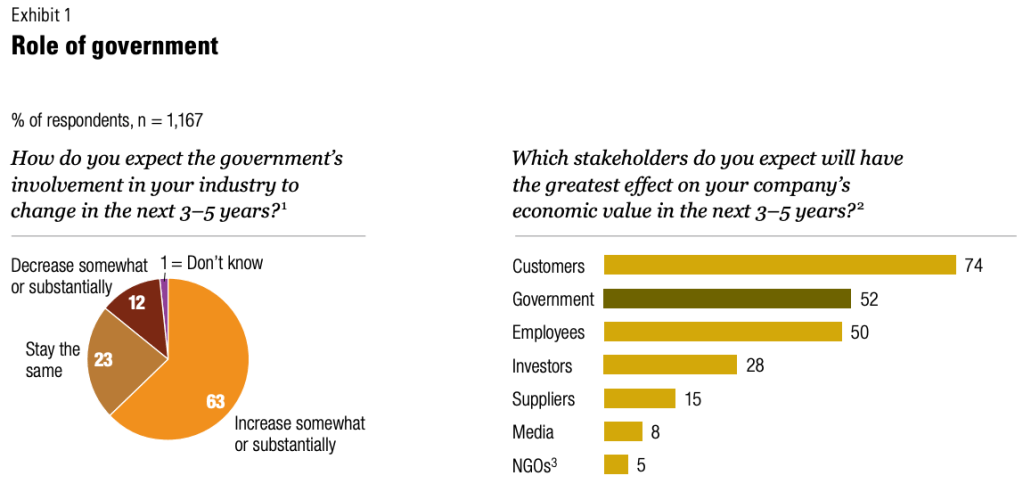
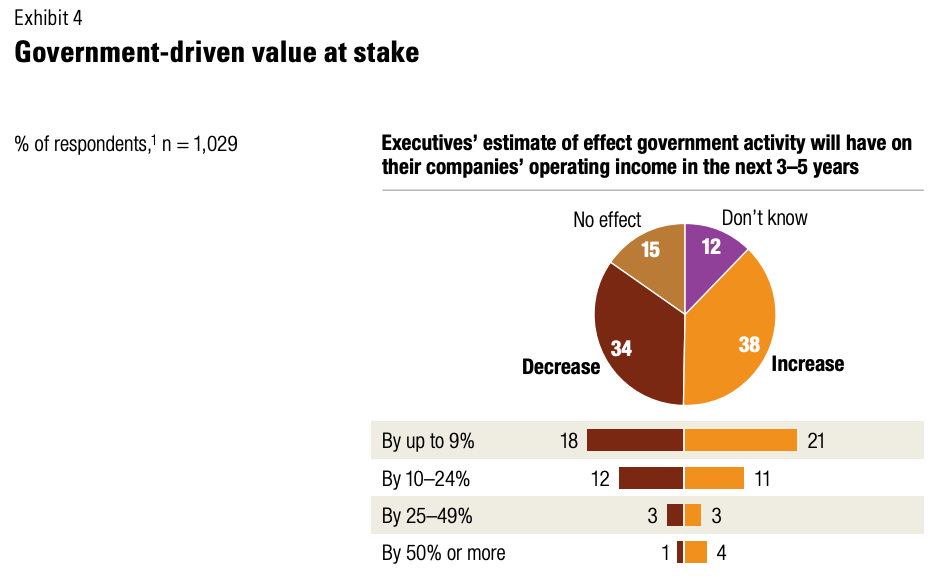
In the 2010 study, executives were asked to estimate how government activity in their industry would change over the next few years. Overwhelmingly they reported it would increase or at least stay the same (86%), and 52% felt government would be the stakeholder with the greatest economic impact on the firm. The story was similar as it relates to operating income – executives were mostly in agreement that there would be a change (72%), but split on the whether that would be an increase or decrease. Selected data is shown in the charts below.

Via McKinsey
Via McKinsey

While this study is from 2010, the many experienced, senior government relations officials we heard from in class confirmed it is still the case a decade later. In short, there is a gulf between where business knows it must be and where it currently sits as it relates to government relations work.

Improving government relations

Despite the data being a few years old, it would seem one doesn’t need to say much to convince leadership of the impact of government intervention. But how does one go about improving the function so that this value is not lost? Or ideally, leveraged into growth opportunity for your firm?

Start by understanding the current and likely future states of government intervention

You must map the current ways in which government impacts your business. This can be across several dimensions: government as partner, as customer, as regulator, or as policy maker. Once you understand the relationships, you can begin to evaluate the various touch points using your internal goals, metrics, and strategies.

For example, in class we learned about an American manufacturing firm that, after researching emerging tax credits for renewable energy technologies, made a strategic shift in their business to build out their green technology vertical. This would have been a missed opportunity without deliberate, proactive work by the government relations team.

Prioritize the issues that can be pursued

Using your map, rank your issues that you’ve uncovered by their relative impact on your business (high, medium, low) and the relative effort and/or cost required to influence them (high, medium, low). You can use a simple two-by-two matrix to draw this out visually. Are there obvious winners (High Impact, Low Cost) or losers (High Cost, Low Impact)? Note them as such and move to the “stickier” issues (High Impact, High Cost; etc). Which of these align most strongly with your goals internally? Asking these questions is essential, as you won’t be able to pursue all of the issues at the same time.

Create campaigns around each issue to make a dent

Once you have your top issues identified, you must think strategically about how to influence the relevant government officials and departments. Your government relations and external affairs staff should be able to organize the resources, tasks, and target stakeholders to support your goals. Be sure to build some flexibility into your strategy – tactics will be your saving grace if you experience any friction.

In another example, we learned about a potential production facility that would be built in a Southeast Asian nation by an American multinational firm. The firm planned to get a US Senator from their home state to make a personal call to the leader of the Southeast Asian nation, but when the Senator declined, they instead produced a joint letter signed by all of the Congresspeople from their state. This is an example of achieving the same goal, without following the strategy verbatim.

Conclusion

Government has a constant and likely growing role in every sector of the economy. In Macroeconomics 101, you are taught that government is the biggest consumer and usually the biggest producer in every country. It makes sense that 30% of earnings would be at stake, and likely much, much more indirectly as well. By creating strong processes internally to research, plan, and implement influence campaigns, companies can flip the script and proactively engage government in ways that benefit both parties.

Understanding Strategy vs. Tactics

This post was inspired by Mr. Timothy Richards, who I had the pleasure of studying under while attending the University of Pennsylvania. His graduate-level course, “Strategic Engagement with Governments,” was among my favorite I’ve taken at any academic level.

Whether you are reading about sport, politics, movement building, or are just mindlessly scrolling your social media feed – you are engaging with strategy almost constantly. Though it is ubiquitous, it is also often misunderstood or misapplied within organizations. Many of my clients came to us with problems that were merely symptoms of deeper issues. “We need to rebrand because the restaurant down the block is crushing us.” “Our website is outdated, so our online donations are down this year.”

It is important to address these surface-level issues in most cases, but in others, you need to start at the beginning. Is that other restaurant really more crowded because of its logo? Are you asking enough supporters to donate to make your goals? These questions move you beyond your presenting symptoms to your central issue. They lead you to strategy.

What is strategy?

In simple terms, strategy is your plan to get from A to B under ideal conditions. With zero friction, changes, or challenges your strategy would lead you on the most direct path to success. It represents why, how, and what for your organization, your team, or a campaign.

For example, your strategy for getting your car washed might be:

  1. Get in the car
  2. Drive to the car wash
  3. Wash the car
  4. Return home

While it is not the most complex strategic approach, it does fit our definition, and it isn’t the only path forward. For example, an alternative strategy might be to simply walk out to your driveway and wash your car at home. This would still get you from A to B – your current state to your desired future state – just in a much different way from the first strategy.

Knowing which approach is best for you will require three pieces of data – knowledge of the past, observation of the present, and forecast of the future. Historically, have you been happy with your local car wash? Do you have time to drive across town and back? Are there other services (waxing, vacuuming, etc) that you will need that can’t be done at home easily? You can imagine applying this to your organization, department, or individual contributions as well.

What are tactics? And how do they interact with strategy?

Once you decide you’d prefer to go out to the car wash, you can begin implementing your strategy. Go outside. Get in your car. Start driving to the car wash. But what happens if something external interferes with your strategy? Let’s say, even though it wasn’t forecast, you notice rain clouds rolling in as you drive to the car wash. No one wants to wash their car right before a storm that will muck it up again. In this situation, you might want to abandon your strategy.

But you have a goal! You want to get your car washed. Do you continue following your strategy? Or do you need to make a change? This is where tactics come in to play. A tactic can be thought of as a tool to use in case your strategy doesn’t work out exactly as it should. You will be reading and reacting to the environment as your strategy unfolds, and tactics are how you course correct or take advantage of opportunities. In the case of the car wash, your tactic might be “retreat” for now, and go back out after the rain clears. This way you still get from A to B, but you are not sacrificing reaching your goal of a clean car (for more than a few hours).

Organizations don’t always do the best with tactics. Oftentimes, leadership promotes their goals over all else. The strategic plan either reigns supreme or sits on a shelf and is replaced with the desires of executives. Tactics can be viewed as “failures” or “abandoning the strategy,” when in reality they are simply a pivot or, to borrow from the negotiation field, the BATNA. If your strategy is to increase turnout at your events, but volunteers aren’t responding well to your free t-shirts, you might consider changing tactics. Maybe diverting that funding to food, entertainment, or childcare would help to bump up your numbers. It doesn’t mean that you were failing, it just means a new tactic was needed.

Conclusion

Your strategy is your plan A – what you would do if there was zero friction and no change in the wind. Tactics are what you need when you rollout your strategy in the real world, and you find that your strategy runs into blockers. Knowing the difference is helpful, but its even more important to get comfortable with moving between the two as you approach your mission.

Using geometry to build better strategies

This post was originally written in November 2019 for the Message Agency blog.

For nearly three decades, consultant Dr. Robert W. Keidel has been asking his Fortune 500 clients somewhat of an odd question: “Is your team playing baseball, football, or basketball?”

Dr. Keidel’s research revolves around strategies for organizations and how employees work together. These patterns are aligned to geometry—parabolas, coordinate planes, and triangles—to visually communicate with a great deal of efficacy. In the sports team question, he reveals a triangle that balances autonomy (baseball), control (football), and cooperation (basketball). Complex organizations will have different “games” being played on different teams and at different levels of the hierarchy, but understanding which is which can frame challenges and opportunities in a new way. 

Since our clients are almost exclusively pursuing digital strategy and digital impact in nonprofit organizations, they can benefit from using these patterns in their organization, whether it’s a foundation, a university, or a small direct service provider. 

How can these patterns help your team become better strategists? 

  • You can create very powerful visuals that communicate effectively
  • Aid colleagues in thinking more strategically about projects
  • Help unearth other patterns in your work more organically every day

The geometries of strategy

There are several different patterns Dr. Keidel uses to describe teams and strategies. We’ll focus on three in this post to get you started. 

Curvilinear thinking (parabola)

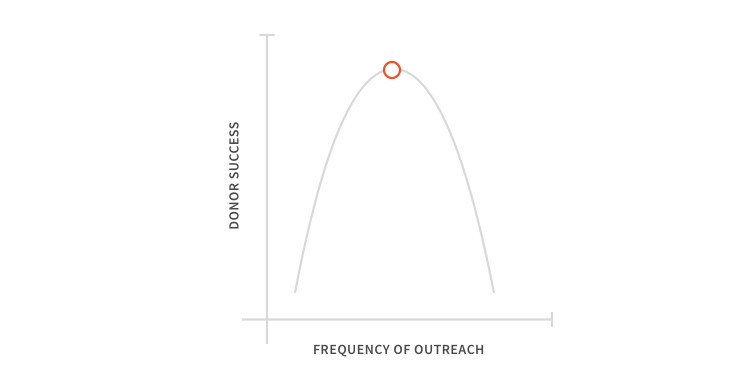
Take the example of your organization’s development or fundraising team. When coming up with a strategy for contributions they must make a determination on how often they will communicate with a given prospective donor via digital channels. Too little outreach and they won’t know anything about your organization. Too much outreach and they’ll unsubscribe, unfollow, and cancel their monthly gift. Finding the sweet spot is key.

A graph showing donor success on the y-axis and frequency of outreach on the x-axis with a parabola graphed on it

Angular thinking (the 2×2 grid)

Dr. Keidel likes to joke that when two strategy consultants meet, the first question is always “What’s your matrix?” The 2×2 matrix is extremely prevalent in strategic thinking as a way to present two variables that must be balanced (or maximized) to achieve a goal.

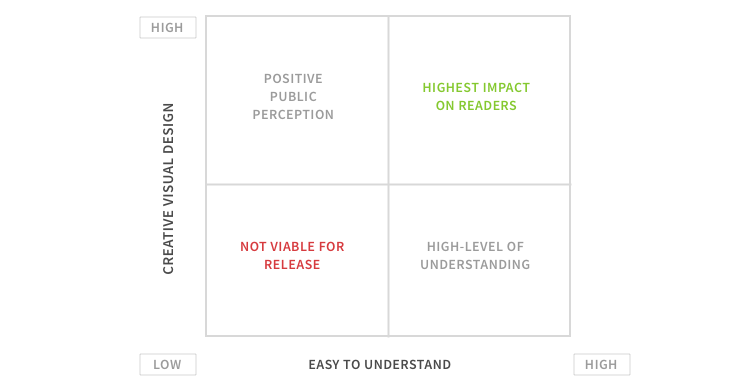
For example, let’s say your executive director wants to redesign your annual report template this year. They meet with the design team and push them to be as creative as possible with the format to capture the attention of donors and supporters. After the meeting, the marketing team discusses their concern about users understanding the content of the report if there are too many bells and whistles. Their mandate shifts to maximize both form and function, not trading off one for the other.

A two by two matrix comparing relative levels, from low to high, of creative design and ease of understanding. The potential outcomes are Not Viable for Release in the lower left, Positive Public Perception in the upper left, High Level of Understanding in the lower right, and the best outcome is the top left - Highest Impact on Readers.

Triangular thinking (autonomy, control, and cooperation)

There are dozens if not hundreds of examples of this pattern across nearly every discipline – from nonprofit strategy to architecture to psychology to finance. 

ExampleAutonomyControlCooperation
Sports teamsBaseballFootballBasketball
Team characteristicsTalentProcessCulture
Performance measureQualityCostTime
Ways to add valueProductOperationsCustomer service

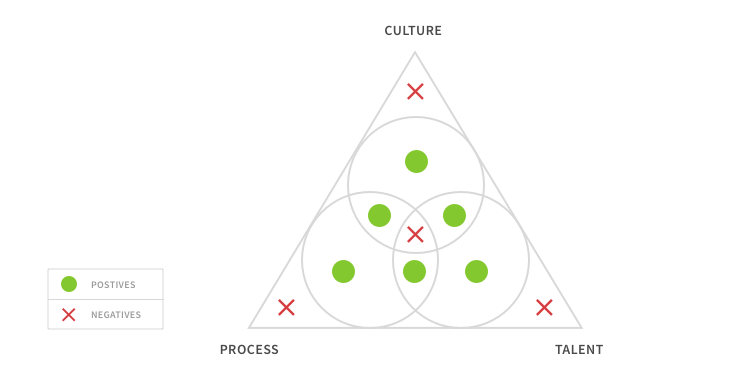
A classic example that applies to any team or organization is the balance of Talent (autonomy), Process (control), and Culture (cooperation). Talent refers to capabilities:  Do you have the right resources to build a digital strategy? Process refers to the “how” of what you do: Do you have a consistent set of steps to follow to achieve your goals? Culture refers to the connections among your team and between teams:  Can you effectively collaborate or are you simply passing tasks back and forth.

A triangle with vertices labeled talent, process, and culture. A three circle Venn diagram is within the boundaries of the shape with various points marked based on their relative viabilities as strategies.

The red Xs are important to note here.  By ending up in the center, you don’t have a true priority for your strategy. By ending up in the corners, you are “under-doing” your bottom priority. As long as you’re in a green circle, you’re in the clear!

You can place your organization in one of these positions based on your perspective. Doing so opens up a host of questions:

  • How might we add the skills or resources we need to implement our digital strategy?
  • What processes can be developed or updated to improve our work product?
  • Who should be part of planning or developing a given program or service? (Hint: You should always be talking to your audience)

Why does this matter?

It’s a fair question! These concepts are abstract and meta (thinking about thinking), but when honed and applied can be very powerful. Picking up these patterns and describing them to your colleagues and collaborators can add value to your conversations—whether you are developing a digital strategy or a strategic plan for your nonprofit. 

Next time you find yourself unsure of how to make a decision, consider whether or not you’re looking for a sweet spot (parabola), an “and” versus an “or” (2×2), or balancing three variables (triangular). If nothing else, you’ll spend less time going in circles!