Understanding Strategy vs. Tactics

This post was inspired by Mr. Timothy Richards, who I had the pleasure of studying under while attending the University of Pennsylvania. His graduate-level course, “Strategic Engagement with Governments,” was among my favorite I’ve taken at any academic level.

Whether you are reading about sport, politics, movement building, or are just mindlessly scrolling your social media feed – you are engaging with strategy almost constantly. Though it is ubiquitous, it is also often misunderstood or misapplied within organizations. Many of my clients came to us with problems that were merely symptoms of deeper issues. “We need to rebrand because the restaurant down the block is crushing us.” “Our website is outdated, so our online donations are down this year.”

It is important to address these surface-level issues in most cases, but in others, you need to start at the beginning. Is that other restaurant really more crowded because of its logo? Are you asking enough supporters to donate to make your goals? These questions move you beyond your presenting symptoms to your central issue. They lead you to strategy.

What is strategy?

In simple terms, strategy is your plan to get from A to B under ideal conditions. With zero friction, changes, or challenges your strategy would lead you on the most direct path to success. It represents why, how, and what for your organization, your team, or a campaign.

For example, your strategy for getting your car washed might be:

  1. Get in the car
  2. Drive to the car wash
  3. Wash the car
  4. Return home

While it is not the most complex strategic approach, it does fit our definition, and it isn’t the only path forward. For example, an alternative strategy might be to simply walk out to your driveway and wash your car at home. This would still get you from A to B – your current state to your desired future state – just in a much different way from the first strategy.

Knowing which approach is best for you will require three pieces of data – knowledge of the past, observation of the present, and forecast of the future. Historically, have you been happy with your local car wash? Do you have time to drive across town and back? Are there other services (waxing, vacuuming, etc) that you will need that can’t be done at home easily? You can imagine applying this to your organization, department, or individual contributions as well.

What are tactics? And how do they interact with strategy?

Once you decide you’d prefer to go out to the car wash, you can begin implementing your strategy. Go outside. Get in your car. Start driving to the car wash. But what happens if something external interferes with your strategy? Let’s say, even though it wasn’t forecast, you notice rain clouds rolling in as you drive to the car wash. No one wants to wash their car right before a storm that will muck it up again. In this situation, you might want to abandon your strategy.

But you have a goal! You want to get your car washed. Do you continue following your strategy? Or do you need to make a change? This is where tactics come in to play. A tactic can be thought of as a tool to use in case your strategy doesn’t work out exactly as it should. You will be reading and reacting to the environment as your strategy unfolds, and tactics are how you course correct or take advantage of opportunities. In the case of the car wash, your tactic might be “retreat” for now, and go back out after the rain clears. This way you still get from A to B, but you are not sacrificing reaching your goal of a clean car (for more than a few hours).

Organizations don’t always do the best with tactics. Oftentimes, leadership promotes their goals over all else. The strategic plan either reigns supreme or sits on a shelf and is replaced with the desires of executives. Tactics can be viewed as “failures” or “abandoning the strategy,” when in reality they are simply a pivot or, to borrow from the negotiation field, the BATNA. If your strategy is to increase turnout at your events, but volunteers aren’t responding well to your free t-shirts, you might consider changing tactics. Maybe diverting that funding to food, entertainment, or childcare would help to bump up your numbers. It doesn’t mean that you were failing, it just means a new tactic was needed.

Conclusion

Your strategy is your plan A – what you would do if there was zero friction and no change in the wind. Tactics are what you need when you rollout your strategy in the real world, and you find that your strategy runs into blockers. Knowing the difference is helpful, but its even more important to get comfortable with moving between the two as you approach your mission.
Using geometry to build better strategies

This post was originally written in November 2019 for the Message Agency blog.

For nearly three decades, consultant Dr. Robert W. Keidel has been asking his Fortune 500 clients somewhat of an odd question: “Is your team playing baseball, football, or basketball?”

Dr. Keidel’s research revolves around strategies for organizations and how employees work together. These patterns are aligned to geometry—parabolas, coordinate planes, and triangles—to visually communicate with a great deal of efficacy. In the sports team question, he reveals a triangle that balances autonomy (baseball), control (football), and cooperation (basketball). Complex organizations will have different “games” being played on different teams and at different levels of the hierarchy, but understanding which is which can frame challenges and opportunities in a new way. 

Since our clients are almost exclusively pursuing digital strategy and digital impact in nonprofit organizations, they can benefit from using these patterns in their organization, whether it’s a foundation, a university, or a small direct service provider. 

How can these patterns help your team become better strategists? 

  • You can create very powerful visuals that communicate effectively
  • Aid colleagues in thinking more strategically about projects
  • Help unearth other patterns in your work more organically every day

The geometries of strategy

There are several different patterns Dr. Keidel uses to describe teams and strategies. We’ll focus on three in this post to get you started. 

Curvilinear thinking (parabola)

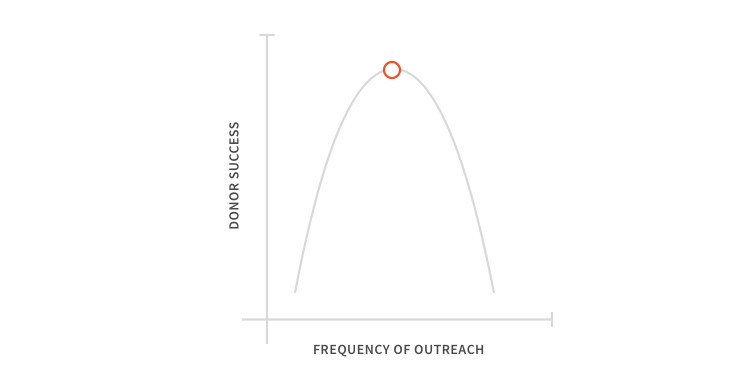
Take the example of your organization’s development or fundraising team. When coming up with a strategy for contributions they must make a determination on how often they will communicate with a given prospective donor via digital channels. Too little outreach and they won’t know anything about your organization. Too much outreach and they’ll unsubscribe, unfollow, and cancel their monthly gift. Finding the sweet spot is key.

A graph showing donor success on the y-axis and frequency of outreach on the x-axis with a parabola graphed on it

Angular thinking (the 2×2 grid)

Dr. Keidel likes to joke that when two strategy consultants meet, the first question is always “What’s your matrix?” The 2×2 matrix is extremely prevalent in strategic thinking as a way to present two variables that must be balanced (or maximized) to achieve a goal.

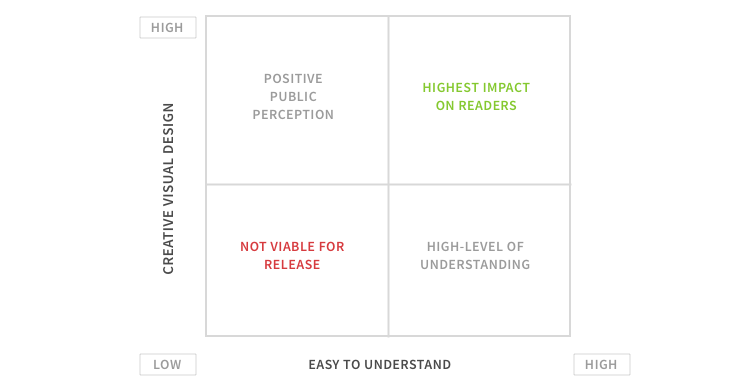
For example, let’s say your executive director wants to redesign your annual report template this year. They meet with the design team and push them to be as creative as possible with the format to capture the attention of donors and supporters. After the meeting, the marketing team discusses their concern about users understanding the content of the report if there are too many bells and whistles. Their mandate shifts to maximize both form and function, not trading off one for the other.

A two by two matrix comparing relative levels, from low to high, of creative design and ease of understanding. The potential outcomes are Not Viable for Release in the lower left, Positive Public Perception in the upper left, High Level of Understanding in the lower right, and the best outcome is the top left - Highest Impact on Readers.

Triangular thinking (autonomy, control, and cooperation)

There are dozens if not hundreds of examples of this pattern across nearly every discipline – from nonprofit strategy to architecture to psychology to finance. 

ExampleAutonomyControlCooperation
Sports teamsBaseballFootballBasketball
Team characteristicsTalentProcessCulture
Performance measureQualityCostTime
Ways to add valueProductOperationsCustomer service

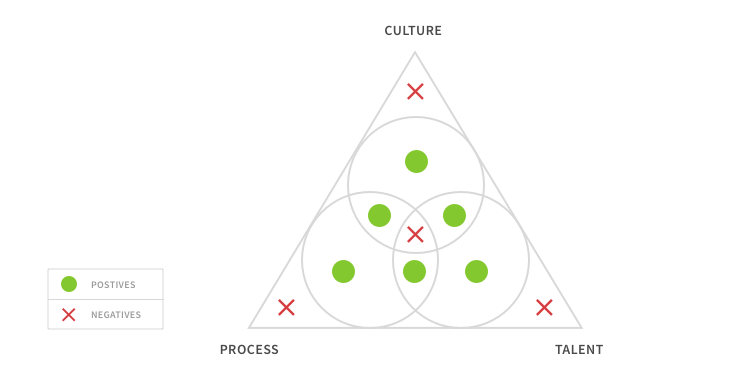
A classic example that applies to any team or organization is the balance of Talent (autonomy), Process (control), and Culture (cooperation). Talent refers to capabilities:  Do you have the right resources to build a digital strategy? Process refers to the “how” of what you do: Do you have a consistent set of steps to follow to achieve your goals? Culture refers to the connections among your team and between teams:  Can you effectively collaborate or are you simply passing tasks back and forth.

A triangle with vertices labeled talent, process, and culture. A three circle Venn diagram is within the boundaries of the shape with various points marked based on their relative viabilities as strategies.

The red Xs are important to note here.  By ending up in the center, you don’t have a true priority for your strategy. By ending up in the corners, you are “under-doing” your bottom priority. As long as you’re in a green circle, you’re in the clear!

You can place your organization in one of these positions based on your perspective. Doing so opens up a host of questions:

  • How might we add the skills or resources we need to implement our digital strategy?
  • What processes can be developed or updated to improve our work product?
  • Who should be part of planning or developing a given program or service? (Hint: You should always be talking to your audience)

Why does this matter?

It’s a fair question! These concepts are abstract and meta (thinking about thinking), but when honed and applied can be very powerful. Picking up these patterns and describing them to your colleagues and collaborators can add value to your conversations—whether you are developing a digital strategy or a strategic plan for your nonprofit. 

Next time you find yourself unsure of how to make a decision, consider whether or not you’re looking for a sweet spot (parabola), an “and” versus an “or” (2×2), or balancing three variables (triangular). If nothing else, you’ll spend less time going in circles!