Consulting Project Management: Strategy & Tactics

When I started my first professional job in Spring 2012, I had no idea that Project Management was an entire industry with certifications, academic literature, and week-long seminars. I was fortunate (or not so fortunate) to never receive this training, and instead developed an approach through trial and error, and lots of great advice and coaching from managers over the last eleven years. This is an attempt to write down what I’ve learned so far, mostly through the lens of a consulting organization.

  • Create a project plan – even if you never update it again.
    • Where can you see there will be disruptions? For example, if your project stretches over Thanksgiving and the December holidays, you already know you’ve lost three weeks (give or take) of time to work – make sure you distribute the work accordingly.Who will miss time from the project team? Vacations, parental leave, etc. Build it in.
    • Other deadlines in other projects you are not leading? Make sure to confirm them with that engagement manager / PM and plan around them, if possible.
  • Set your milestone dates in advance, if possible, and work backwards.
    • Where possible, ask Clients or MD / Director for any natural milestones to tie our work to – i.e., council meetings, election cycles, budget cycles, etc.
  • Insist on having an internal kick-off meeting
  • Make sure you have a kick-off meeting with the client, too
  • All tasks should have a deadline, all deadlines should assume one additional round of revision.
    • For example, we need to draft an outline for a final report on tax policy recommendations; this task needs 1) due date to the client (meeting scheduled already), 2) final version sent to client ahead of time (if applicable), 3) date to be sent to “reviewer” (I.e., Director, SME, etc.), and 4) internal meeting to discuss / brainstorm (if needed)
  • Learn to love your calendar. As an analyst, meetings are few and far between. As you’ll soon read in this guide, being a great PM will require a solid number of productive meetings. At many firms, you’ll still be expected to do significant analyst-type work – often up to and including your time as a senior leader. Use the points below as a guide to get started.
    • Schedule out as far as you can – when possible, set meetings to be recurring (bi-weekly, monthly, or even quarterly in some cases).Schedule your analyst tasks as meetings with yourself. If you need three hours to write a report or ninety minutes to QC someone’s analysis, put it on the calendar. If you need to stop for lunch (Author’s note: I do my best to schedule my lunch hour a month in advance), then make sure you have an hour booked mid-day.
      • IMPORTANT NOTE: Once you get consistent at booking this time, anyone viewing your calendar will have a more accurate understanding of how “busy” you are at any given time. (Author’s note: This is why more senior members of the team regularly look at my calendar and say it looks more packed than theirs. The truth is they probably have just as much to do, but I look “busier” because I’ve actually tried to account for all the hours I need to do the work!!) This is invaluable when it comes time to honestly communicate your capacity to meet a tight deadline or add another project midstream.
    • Adopt “Power Scheduling” principals. Like all good management systems, no one follows this 100% of the time, but in general, these guidelines help with productive work flows:
      • Know yourself! When do you do your best work? Make sure you are scheduling your most important tasks / meetings for those windows whenever possible. Getting ahead and staying ahead helps here, for sure.  As an example, I often start to drag around 2PM, so I will try to schedule low-value meetings during that time since I won’t be doing much work anyway.Know your team. Don’t be inflexible, and don’t say ‘I’m doing this to follow Power Scheduling!’ Just default to these choices and the rest will fall into place.Book yourself back-to-back, but not all day. Two one-hour meetings or three thirty-minute meetings is probably the outer limit of what can be productive if you are leading each one. Schedule a break in between, then go back-to-back again if possible.Monday / Friday: Internally focused days and nights. Try to schedule as many of your internal meetings on these days as possible. Reserve your evenings for time with family, friends, etc.Tuesday / Wednesday / Thursday: Externally focused days. Schedule your client meetings and internal working meetings for these days. Reserve the 9AM, Noon, and 4PM hours for yourself (sending emails, having lunch, etc). These are the target days for any after work professional / networking type events or outings. These responsibilities are very infrequent early in the PM’s career, but increase over time.Saturday / Sunday: Can be used sparingly for work. In the official Power Scheduling system, Saturday morning is reserved for closing out any items that didn’t get attention during the week. I don’t personally find this valuable except when I’m really swamped, but obviously your mileage may vary.
      • FINAL NOTE ON POWER SCHEDULING: Again, it’s not an exact science. The keys are being mindful of the things you need to do each week, and making them as repeatable and as simple as possible. Once your calendar is pre-loaded with some of these “big rocks” you can fill in around them more easily.
  • As a general rule, assume no one will do anything related to your project unless you directly tell them it is their responsibility and that it is needed by a certain date / time; even then, be sure to follow-up if you do not hear back from this person in a reasonable timeframe (silence is almost never an affirmative answer).
  • Relatedly, if you are assigned to a project and no one else is obviously the project manager, consider yourself the project manager unless and until someone else tells you not to play that role.
    • This would apply to tasks like scheduling, note taking, meeting agendas and follow-ups, etc.
  • Goals, Roles, and Budget – the most important parts of every project.
    • Goals: from the client and MD / Director – what does success look like for this project? What specifically does the client need from us (i.e., capacity, guidance, a specific deliverable, etc.)?
    • Roles: who is the project lead (“Engagement Manager”)? Who needs to sign off on major documents / presentations / etc.? Who leads the regular meetings? Who is the project manager (“second chair”)? Who is the analyst?
      • Project Roles also apply to (and may differ from) roles related to specific documents and meetings, see more on this below
    • Budget: for a given organization, this may be more about time than money – so be sure to apply your leader’s approach to this element of PM.
      • Based on the scope of work, who is expected to do the majority of the work? Who else can be involved as an expert or support if needed for extra capacity? How much is the project worth – and by extension, are we comfortable going over budget for any particular reasons (i.e., opportunity for staff training, marketing purposes, helping to win future work, etc.)?
  • Ship something every two weeks. It will probably need to be in draft form in many cases – this is a good thing! It forces the PM to play more of a role in creating templates or very early drafts for internal work.
    • If this fits your project plan, great. If not, consider how you can have some “thing” (a topic, a draft document, a key question) to bring to each bi-weekly meeting.
    • Always try to deliver your major project deliverables at these bi-weekly meetings – it saves time on scheduling and keeps your client on a rhythm of focusing on this project.
  • As a result, meet with your client once every two weeks.
    • Depending on the project, this may not be entirely necessary; meeting frequency should be agreed upon by your team and the client as part of the kick-off meeting
  • Notes on scheduling any and all client meetings, including bi-weekly meetings:
    • Always provide at least three options for dates / times
    • Always clarify the length of the meeting – 30 minutes, 60 minutes, or longer, as needed (and only with Client / Engagement Manager approval).
    • Always provide times in the time zone of the client (or most senior person on the client team, if it differs)
    • Use calendar HOLDS when scheduling for someone with a tight calendar (I.e., most MDs and Directors); this means sending calendar invitations for each meeting window clearly labeled “HOLD – PROJECT X MEETING” and sending these BEFORE you send the email to the group you are scheduling
    • Once the meeting is scheduled, delete the HOLDs you no longer need
  • Meetings must have an agenda and clearly assigned roles – who will present what, who is preparing any documents to present, who is sharing their screen, etc. The level of preparation definitely scales according to the importance of the meeting, though it should always be clear
    • If no clear agenda, reach out to those attending to ask for topics or to cancel.
    • Meetings must have an assigned notetaker, and they MUST identify the next steps and who is responsible for each.
  • Documentation must be intentional and consistent. Ideally, every activity in a project will be captured by some sort of documentation. Without this documentation, you can easily get lost or forget a critical decision. (Author’s note: This recently happened to me with a project where roles were inconsistent, and I made the mistake of not assuming notetaking responsibility. The decision I did not capture was pretty important – the date selected to launch a survey).
    • Meeting notes: Every meeting should have notes taken and saved in a central location. If there were not noteworthy items in a meeting, it should not have happened in the first place!
    • Emails: As a general rule, I try to not have something in email only, because it is unreliable and less accessible than a shared drive. However, for internal items or basic information sharing, it is of course an acceptable document. If you write a great email with lots of information in it, consider printing it as a PDF and saving to the client drive.
  • Meetings must have a follow-up email, promptly (within 24-48 hours of meeting) with clear and direct next steps, assignments, and deadlines.
    • Use bullet points to separate out the next steps
    • If scheduling a meeting is a next step, consider whether to include it in this message or send a separate email to the relevant project team members
  • Internal meetings – as needed, but assume you need more than you do. Meet too much first.
    • Again, having an agenda is critical; roles can vary by what type of meeting – if you want to brainstorm something, prompt the team so they come prepared; if you want to present a draft of something, consider whether you need to send it ahead of time (not a requirement)
    • For managing specific analysts, consider a once-per-week check-in for 15 minutes, three question agenda
      • What did you work on last week?
      • What are you working on this week?
      • Are you stuck anywhere / on anything?
  • When in doubt, send an email.
    • How are we feeling?
    • What did you think of that meeting?
    • Where should we go next?
    • Should we ask an MD / Director / Senior Advisor what they think?
    • Does the timeline still feel right? Do we need to speed up / slow down / change something?
Effective Change Management in Equity Implementation

This white paper was a collaboration between myself and Matt Stitt, as primary writers and researchers, and Mike Nadol as editor. It was created as part of PFM’s work in the Bloomberg Results for America City Budgeting for Equity and Recovery program in 2021. Due to formatting limitations, footnotes have been excluded from this text-based version. The fully designed PDF, including all citations, can be viewed here.

Introduction

Changing practices to drive greater equity can be extremely intimidating for cities not yet substantively educated or exposed to the relevant concepts, and, for those within cities that perceive their status or authority as being threatened by the adoption of new principles. This is especially the case given today’s turbulent environment.

Creating a sense of urgency for change can be relatively easy as an executive, but significantly less so as a subordinate. Finding champions can seem impossible if cities are struggling to get stakeholders to even entertain a particular topic. Simultaneously, both proven and emerging change management practices can be deployed to help overcome these challenges and dramatically improve the probability of success.

If an individual seeking to make change lacks a traditional leadership position, active supporters for their cause, or simply does not know where to begin, this guide can help them model an approach to lead from where they sit, and effect sustainable, enduring organizational change.

As part of our ongoing work with the cohort of cities looking to make transformative change through the Bloomberg Philanthropies/What Works Cities/Results for America City

Budgeting for Equity and Recovery (CBER) Initiative, the following represents a combination of lessons learned and promising change management practices that have emerged over the duration of the Initiative.

What is Change Management?

Fundamentally, change management speaks to the process that ultimately drives a city’s culture (and, to quote the renowned Peter Drucker, “culture eats strategy for breakfast”). We are more specifically speaking to the process that drives a city’s new program, initiative, or strategic focus to gain additional, necessary buy-in from stakeholders across the entire government. This can take place at any level within the organization – from one’s mind to one’s team, and from one-on-one relationships with global institutions – and many of the critical factors will remain very similar. Some of the standard best practices include

  • Creating a sense of urgency; action must be taken quickly.
  • Finding champions to help spread the word, implement changes, and eliminate barriers.
  • Establishing working groups, committees, or task force teams (composed of champions and subject matter experts) to lead change effort(s) across government.
  • Focusing on short-term wins to build momentum on the way to long-term success.
  • Reinforcing the established change at a systems level.
  • Creating continual, evaluation and feedback loops to better inform future refinements.

While these are tried and true tactics that can support your city’s /team’s leading efforts to improve upon the existing culture, and to achieve the brighter future your city envisions, it must be acknowledged that aligning a large organization can be challenging, particularly in the public sector. To tackle this specific type of change management challenge related to equity, PFM has curated a series of promising practices from across the U.S. that can be applied to your unique opportunity to refine your department’s operations, municipal operating budget, or capital improvement plan.

Promising Practices in Change Management for Equitable Principles

Traditional change management best practices assume a certain level of power for decision-making and political capital committed by the initiative’s champion, a certain level of responsibility vested in the person or team charged with leading the change, and a general level of awareness that the existing culture must be altered or disrupted to achieve desired outcomes. The practices that follow not only recognize these dynamics, but also seek to foster and leverage them for impact.

Conduct a brief, informal environmental scan

The goal for this is to make certain you have a general understanding of how equity work has been conducted in the past and to what extent it was successful. This can include a consideration of peer organizations – however, their relative success or lack thereof is not necessarily predictive of your own experience. Keep cultural, political, and demographic realities in mind when making comparisons and avoid digging too deeply into quantitative data at this stage.

In a recent project with the City of Chula Vista, CA, the project team spoke with several departments that had previously published equity-centric documentation to ask about their process and goals. The team was able to collect equity definitions and other data points to bolster their own work. This also led them to uncover additional equity champions that could be aligned to their specific project goals.

Identify the key players, both champions and detractors

If you cannot make the final decision, who can? Who else has influence over the decision, or the ultimate implementation of the decision? Is there a way to turn our detractors into champions? If so, how should we pursue the best path to securing that buy-in?

Start by creating a rough power map as it relates to your city’s goal. A simple format to consider is an “x” and “y” axis showing more or less influence in one dimension and more or less support for your position in the other. Understanding these change management power dynamics and how they impact decision-making authority and workflows, will help you plot the most efficient course of action.

Establish a working group, steering committee, or task force comprised of champions to lead change

Establishing working groups, committees, or task forces can further support communication, coordination, and collaboration efforts across the government. If existing, effective groups are already up and running for cross-cutting initiatives or priorities, joining those committees might be an effective way to make progress and find others that support your cause. The larger and more complex the government entity, the greater the need to join or establish a formal working group or committee to lead these efforts. These teams should also include “A-Team” members, to ensure that the change remains a substantive and visible priority. Diversity of department and positions is crucial as was outlined in a recent ICMA study of the City of Evanston (IL). In this example, Evanston intentionally built their equity committees through diversity of positions, departments, and supervisory responsibilities.

When defining equity in your jurisdiction, focus on metrics, not just language

While a baseline understanding of the definition of equity (for example, how it is different from equality) is typically helpful in regards to getting your team thinking similarly, the conversation will inevitably move to “how do we measure this abstract concept?” In many places, governments are adopting place-based, third-party definitions that are often set by and monitored through federal agencies, such as the Center for Disease Control’s Social Vulnerability Index or HUD’s Qualified Census Tracts (QCT). Focusing on these types of metrics, initially, helps to alleviate pressure on any individual that may be seen as “defining equity” for an entire community (that person should be, but may not be, engaged in this process). It also generally aligns with federal and state funding streams, which can be a useful leverage point when discussing the fiscal implications of this type of focus (e.g.., if we use HUD’s definition, it is highly likely we can apply for grants that support impactful programming on this metric).

In Harris County, TX, City officials have started to use the CDC’s Social Vulnerability Index more consistently across multiple areas of their operating and capital budget processes, including flood plain project prioritization and small business relief. Using the same metric across both programs allows for a comparison of outcomes, and consistent reporting across departments.

Be aware of existing leadership priorities, as well as timing of electoral cycles

When pursuing equitable change, it is critical to understand where leadership stands in relation to your own vision of equity. If appropriate, consider ways to elevate this work to the executive themselves, or, more likely to their deputies and key support staff. If the elected official can take things a step further by issuing a jurisdiction-wide mandate, or even an executive order, it will likely  set the tone for equity work across the organization, and can also further the push for more alignment with larger organizational goals, as well.

For example, one city in the City Budgeting for Equity and Recovery cohort that is working to increase equity in its capital budget discovered that a key driver to completing more equitable work is the amount of available discretionary capital funding each year. If the Mayor, City Manager, and other city leadership can articulate the need and scale of deferred maintenance, and can make a collective, unified push for additional funding from other entities (e.g., philanthropic and state and federal government), it would be a more powerful push than coming from the budget office alone, and, should increase the chances of securing additional funding for all proposed capital projects.

If your city’s administration and leadership are coming up on the end of their term(s), consider how this kind of work may be impacted (positively or negatively) by the result of a primary or general election. While there should be urgency around equity in all cases, the timing of when to pursue certain conversations, policy or process changes – and potential presentations or reports  – must follow a logical cadence that considers the practical and feasible focus of the administration(s) at any given moment.

Understand the perspective of your key detractor(s)…

If your internal detractors are substantively reliant on key data for their work, this factor should inform how you formulate a persuasive argument, and strategically approach the conversation or meeting with these stakeholders. For example, if your city’s team is attempting to change public works’ policies, your team may need to dive deeper in regards to where the more granular data stems from, how often projects are similarly (or identically) rated, and what level of subjective prioritization comes into play at more senior levels of the organization – to offer a more relevant context or perspective.

 In San Diego, CA, street projects are prioritized based on street condition, proximity to one another, etc. This can be considered an asset quality-centric approach to budget allocation. In Oakland, CA, a similar process is used, however, Oakland also incorporates equitable factors in their prioritization criteria. For instance, individual complaints are not included as rationale for paving a particular street, and geographies considered “underserved” by the City’s definition receive preference in project funding. This additional layer of consideration can potentially counteract persistent underfunding of some community priorities.

…And, where possible, use these conversations to create champions

To further the capital budget example, perhaps your equity team meetings with this department team reveal a lack of sustainable, discretionary funding for projects that are not tied to grants, nor state or federal aid. One potential solution is to use your team’s equitable push as a starting point to request increased funding for all capital projects, and, in particular, those aligned with equitable principles. In Oakland, CA, when the city was revamping its capital improvement plan, working groups focused on getting feedback and input at multiple points along the way to ensure buy-in, and to create champions for the plan. This type of broad engagement approach allows you to aggregate feedback and frame your goals in a shared, inclusive context that can be supported by all involved.

In all cases, advocate for low-effort reporting and transparency initiatives

For example, if your  team would like to change the decision-making process for funding new programs in the local  government’s jurisdiction, that may take significant staff time

and effort to design ahead of upcoming budget cycle(s). However, if your internal  team could introduce a new variable in a shorter timeframe for reporting on budget figures, it may be possible to clearly demonstrate a need for new decision-making criteria when faced with data on the growing disparities among various communities.

In Baltimore, Mayor Brandon Scott has made a significant push towards transparency and open data on many city services, including those related to COVID-19 recovery. This includes real- time, public dashboards that show spending trends for the City and its agencies. Recall the prior recommendation on initially using metrics as definition(s) of equity – by simply including a report of spending by the CDC or HUD geographical variable, any city could display potential opportunities to increase equitable spending.

The Three Cs of Change Management

When in doubt, focus on the Three Cs: Coordination, Communication, and Collaboration

As the COVID-19 pandemic demonstrated, an increasingly unpredictable future requires new ways of thinking about government operations. When the critical moment is upon you, it is too late to plan for what you might do. Preparing for these scenarios is ideal – however, if your organization is facing a new challenge, the “three Cs” should be your default methodology for quickly establishing alignment, effectively sharing information, and working across silos to deliver critical services and save precious time and resources along the way.

  • Racial Equity and Reconciliation Initiative Team, City of Long Beach (CA) – In June 2020, City Council members in Long Beach, CA, unanimously approved a resolution to review historical inequities related to Race and other demographic factors. This cross- departmental team was responsible for engaging residents on how best to eliminate systemic racis
  • Stimulus Task Force, City of New Orleans (LA) Following the announcement of $375 million in federal funding, New Orleans Mayor LaToya Cantrell convened a 28-member task force with five sub-committees representing priorities for the City. This group was tasked to identify the best opportunities for spending, as well as explore potential funding available through subsequent rounds of ARPA guidance.13 The City adopted this strategy based on multiple prior experiences with federal relief funding, in the wake of hurricanes and associated flooding. Ultimately, this team delivered a comprehensive report and recommendations for enhancing racial equity in the City.

Conclusion

With increased federal funding to support economic recovery in the wake of COVID-19, cities are being handed the keys to allocate CARES, ARPA, and any future federal dollars toward more equitable programs and services. Resistance to equity may show up in an organization as skepticism around these funds and their purposes – however, the guidance for CARES Act, ARP Act, and (likely), any eventual Infrastructure Bill all incentivize investment in previously neglected communities. Sharing plans for this spending alongside the annual operating budget can further demonstrate a comprehensive response to constituent needs and goals, regardless of the funding source. As these federal programs pave the way, one’s change management muscles must be well-developed to take on budgeting for equity, and other equitable initiatives in additional contexts.

Ultimately, change management is about shifting the existing culture – preserving the great things about an organization while restructuring and updating its activities and service delivery to better align with its core values and priorities moving forward. In an ideal world, this might happen with the flip of a switch – however, even the best plans cannot be
developed nor successfully implemented in the real world without a receptive and supportive culture.

Equity in Capital Improvement Planning Processes

This white paper was a collaboration between myself, as primary writer and researcher, and Matt Stitt and Mike Nadol as editors and contributors. It was created as part of PFM’s work in the Bloomberg Results for America City Budgeting for Equity and Recovery program in 2021. The fully designed PDF can be viewed here.

Why This Matters?

Capital budgets and improvement plans present exceptional opportunities for governments to drive equitable outcomes in municipalities, particularly when budgeting for recovery. The significant spending power authorized through capital budgets – multiple billions for some jurisdictions – can allow for increased, targeted spending on geographies that historically lacked investment from the public and private sectors. In addition, the job creation necessary to complete these projects offer workforce and economic development opportunities for residents and businesses. Because the Capital Improvement Plan (CIP) typically requires a multi-year plan and planning process, it provides a framework that can be adapted to equitable purposes rather than created from scratch. When taken together with the scale of funding available, the CIP presents a ready-made strategy for planning, implementing, and evaluating projects that achieve enduring equitable outcomes.

Introduction

Infrastructure is the fabric that enables community connection, economic opportunity, and civic life in the United States. Eighty percent of public spending on these vital projects (from roads and bridges to parks and recreation centers) is provided by state and local governments. Yet despite its importance to everything from commerce to public health, the national total deferred maintenance on infrastructure assets could be as high as $1 trillion.[1]

Additionally, most cities have no structured mechanisms to incorporate equity considerations into their capital investment planning. Equity-based approaches to funding, project selection, and community input are still evolving and imperfect at best – but such approaches are now developing rapidly for operating budget allocations. To next integrate equity into longer-term financial strategies, Finance Directors, City Managers, and senior Elected Officials must all double-down on their efforts, sharpening their focus on capital investment planning. While there is no single solution that works for most cities – when it comes to matters of equitable impact, the best option is one that is place-based and reflective of the needs of a specific community. Ultimately, the process for equitable capital budgeting must be developed collaboratively and implemented through a thoughtful change management strategy.

This resource outlines a few strategies and case examples (related to equity in capital planning), from across the country, that can be adapted to the local context.

Using Capital Improvement Planning (CIP) Process to Drive Equitable Outcomes

To approach the CIP process in a manner that creates consistent, measurable, equity-focused results, PFM recommends first mapping the current process being used (including a timeline for key milestones) and bucketing the tasks into phases. Each of the following examples can be considered as a potential improvement to one key phase (i.e., swapping a current practice for a new tactic) or as part of a more comprehensive effort across the full process. Depending on local readiness, needs, and priorities, government staff can choose an approach that is politically feasible while building toward maximized impact.

Prioritize Projects that Align with Long-Term Strategic Goals

The Government Finance Officers Association identifies “identifying, tracking, and communicating” performance measures in budgeting, including the capital budget, to be a financial best practice.[2] To make such performance measures most impactful, city staff must align these metrics to the overall goals set by city leadership. In the City of Seattle, WA, for example, equity goals have been set by the Seattle 2035 comprehensive plan – and the City’s scorecard for capital investments uses detailed, quantifiable criteria to rank projects in terms of alignment with these goals.[3] Projects that score high on these measures (and, thus, are highly aligned to the plan) receive higher priority for funding than those with relatively lower scores.

Develop a More Impactful Community Benefit Agreement Structure

If well-designed, Community Benefits Agreements (CBAs) centered on equity issues can be extremely impactful for cities. In Sacramento, CA, for example, a recent CBA developed for a multi-billion-dollar mixed use development generated $50 million in funding for affordable housing, anti-displacement investment, prioritized hiring for residents, and improved public transit infrastructure. These benefits were developed, prioritized, and supported by direct resident input. The evaluation firm highlighted dialogue with community members (versus presentations) – designing projects that not only increase revenues, but also deliver non-monetary benefits to residents and businesses. The firm also recommended reevaluating success measures (i.e., rethinking straight, or traditional, financial return-on-investment).[4]  

Formalize “% for X” Investment Goals in Major Capital Projects

The strength of the capital budget and plan as a tool to promote equity is that its spending power, especially when viewed over a multi-year time horizon, can dwarf the operating budget of a municipality. With this scale in mind, cities should consider a formal set-aside of X% in major capital projects (e.g., all projects with budgets over $2 million) – for the sole purpose of funding an equitable priority project. As an example, the City of Austin, TX, recently dedicated $300 million of a +$7 billion transit expansion program to affordable housing and anti-displacement programs for near neighbors.[5] Not only does this provide funding for an equitable priority, but also enhances the value of the transit assets themselves through potential increases in ridership.

Connect Capital Budgets and Workforce Development

All cities seek a robust, skilled workforce and a strong local economy – however, oftentimes workforce development funding is tied to imminent or even pre-existing job opportunities. By taking advantage of capital investments to drive small business growth and the development of local supply chains, municipalities that design creative programs (or partnerships) can generate a positive feedback loop of a stronger labor market, growing local firms, and increased quality and efficiency of capital projects. For example, one city in the current Bloomberg Philanthropies/What Works Cities City Budgeting for Equity and Recovery cohort is working to design a sidewalk maintenance program that would include a set amount of work conducted each year by apprentices and workers seeking employment. This helps to improve walkability and economic activity, while also training residents to work in trades that offer family-sustaining wages and add value to businesses in the City.

Seek Strategies for Co-Investment

State and federal funding can be a source of “fuel” for capital project development. Enterprising city staff can apply for grants that award funding for not-as-obvious capital investments that expand program capacity, and, in the best-case scenario, generate a return to both the city and its residents. The Philadelphia Energy Authority’s Solar Savings Grant Program, for example, leverages funding from the Commonwealth of Pennsylvania for green energy projects to offset the cost of installing solar panels on low- and moderate-income households’ roofs.[6] The grants lower the overall costs of the program, residents save money on their electric bills each month, and the city decreases its overall carbon footprint. 

Set a Future-Focused Investment Strategy

An additional way to better leverage capital budget dollars is to invest in growing service areas based on demographic trends, and strategies that can reallocate funding to more equitable priorities. For example, there are mobile crisis teams operating in at least 25 cities across the country, and many more around the world. In Eugene, OR, the CAHOOTS program, a pioneer in this space, cost approximately $2 million to operate (in 2019), and is estimated to have saved approximately $23 million in public safety and public health costs.[7] While models for service delivery vary depending on the local context, cities that choose to develop this capacity internally can leverage capital investment to establish facilities, and potentially to procure first-response vehicles and other durable goods, that contribute to the treatment process. With such support, mobile crisis programs have the ability to lower the needed capacity in public safety (e.g., police and/or EMS/EMT first responders) and public health (e.g., hospital beds and social worker FTEs) over time. Investments like these also create an equitable outcome of clinically appropriate care delivered to residents in need (i.e., instead of holding residents in prison or police custody without timely treatment) while diverting from corrections populations and overburdened emergency rooms.

Callout Features – Case Studies

Redefining Return on Investment (ROI) through an Equity Lens

Moving towards equitable formulas for funding CIPs will naturally raise questions regarding ROI (i.e., will projects generate a financial return). Evaluation is a critical component of all capital investments, and these examples provide a clear guide.

  • In Harris County, TX, officials recently moved away from the historical practice of using traditional ROI based on the financial value of property protected by its flood projects (which tilted investment heavily towards high-income neighborhoods) to using a social-vulnerability index created by the Centers for Disease Control and Prevention (CDC), which moves more funding to areas with the most at-risk populations.[8]
  • In Raleigh, NC, the city explicitly measures environmental and social, as well as economic, outcomes of projects (the “triple bottom-line”) in its 2030 Comprehensive Plan.[9]

Use Change Management Best Practices to Build Support

Our most successful clients take a strategic approach to engaging internal and external stakeholders who are considered potential champions or detractors to implementation.

  • For example, traditionally information is presented to community groups for comment and approval, but a fully equitable approach would be to engage the community up-front in a true dialogue to understand priorities, concerns, and opportunities for both sides while the program is still under design.
  • Tools to consider include using steps from Dr. John Kotter’s Model[10], adapted and customized for more effective “place-based” or local use.

Conclusion: Importance of Investments in a More Equitable Future

Many municipalities currently face a myriad of deferred maintenance and equity imperatives – all of which have been exacerbated by the COVID-19 pandemic. The path to reversing severe long-term under- and disinvestment must include large-scale, strategic capital program initiatives. Through engaging their communities, cities can address both historical disparities and identify investments that can build towards a more equitable future.

“The best time to plant a tree was 20 years ago, the second-best time is now.”

A common theme across the strategies documented here is the importance of change management to creating sustainable change. Whether starting from a top-down directive (e.g. executive order) or a bottom-up approach (e.g. employee-led, department level change), understanding the stakeholders involved and the relevant processes is critical to designing a more equitable approach. Another factor embedded in each of these strategies is the availability and monitoring of disaggregated data to ensure that all residents benefit from the changes implemented.

As equitable considerations take hold and begin to shift the balance of capital investment dollars to the previously neglected corners of the local map, municipalities should become better places to live, work, and enjoy for all residents. When combined with strong community engagement, data-driven project criteria, and thorough measurement and evaluation, funds that seemed too limited will deliver results above and beyond their scale. With the first American Rescue Plan Act (ARPA) funds arriving to cities, states, and counties in the last month, and recent, additional infrastructure spending discussed at the federal level – now is the time to prepare stakeholders to rise and meet the moment.


[1] Zhao, Jerry Zhirong, et al. The Volcker Alliance, 2019, pp. 1–40, America’s Trillion-Dollar Repair Bill.

[2] Performance Measures, http://www.gfoa.org/materials/performance-measures.

[3] City of Seattle, Office of Planning & Community Development. Community Planning: Practice + Prioritization, pp. 4–32.

[4] Hackler, Darrene. Smart Incentives, 2021, pp. 1–5, Community Benefit Agreements: An Equitable Tool for Innovation District Development.

[5] Young, Harrison. “Austin Transit Partnership OKs Anti-Displacement Funding.” Austin Monitor, 18 Mar. 2021, http://www.austinmonitor.com/stories/2021/03/austin-transit-partnership-oks-anti-displacement-funding/.

[6] Philadelphia Energy Authority, “Solar Savings Grant Program.” https://solarizephilly.org/solar-savings-grant-program/

[7] Reach out Response Network, November 2020, pp. 1-91. Final Report on Alternative Crisis Response Models for Toronto.

[8] Wallace, Don. “A Climate Plan in Texas Focuses on Minorities. Not Everyone Likes It.” The New York Times, 24 July 2020, https://www.nytimes.com/2020/07/24/climate/houston-flooding-race.html.

[9] City of Raleigh, Office of City Planning. 2030 Comprehensive Plan – Update, pp. 123-124.

[10] “The 8-Step Process for Leading Change: Dr. John Kotter.” Kotter, 7 May 2021, http://www.kotterinc.com/8-steps-process-for-leading-change/.

Kotter’s Model: How a change management approach improves digital projects

This post was originally written in September 2019 for the Message Agency blog.

Digital projects usually seek to both decrease costs and increase efficiency through the use of technology. If the choice was “either-or,” these projects might not be as attractive to decision-makers. Most want to understand the “both-and” proposition.

John Kotter spent nearly three decades on the faculty at Harvard Business School. His 1996 book, Leading Change, was an international best seller. In 2011, TIME® magazine listed it as one of the “Top 25 Most Influential Business Management Books” of all time.

While it is most commonly taught in leadership and management contexts, I find his 8-step process for managing change to be invaluable for managing projects with our clients. To paraphrase Kotter on the topic, there are two fundamental goals at the heart of most digital projects:

  1. Increase revenue / equity or decrease costs
  2. Become more effective / efficient

Many astute managers would ask the question:  Why not both? Digital projects, in particular, usually seek to both decrease costs and increase efficiency through the use of technology. If the choice was “either-or,” these projects might not be as attractive to decision-makers. Most want to understand the “both-and” proposition.

Fortunately, by following some of the key steps in Kotter’s eponymous model, you can manage costs and increase the effectiveness of your digital project.  Achieving this goal is particularly important for nonprofit organizations and others with limited budgets, who need to ensure a substantial return on their organizations’ investments.

Urgency, Urgency, Urgency!

Like the famous rallying cry of real estate agents everywhere regarding location, the one thing your project simply can’t do without is Urgency. The unfortunate reality is that some projects will fail for one reason or another. You’ve probably been part of projects that got off the ground but couldn’t stay the course. Or maybe one decision maker’s flavor of the week replaced a more sustained effort from years past.

Regardless of the context you find yourself in when embarking on a new digital project, it is imperative that you find a source of urgency. This can come in many forms, including:

  • Executive sponsorship and support (e.g., your new ED recognizes a need to improve the website);
  • Alignment with a key milestone (e.g., your organization is celebrating its 50th year in operation);
  • Acknowledgement of the danger in maintaining the status quo (e.g., your website is end-of-life next year, and you need to raise funds for a redesign). 

Wherever you find your sense of urgency, Kotter recommends that you should do what you can to protect it!  We agree, as 50% of transformations fail at this first crucial step. Maintaining a sense of urgency means your project will be more likely to get prioritized by you and your colleagues.

Great Guiding Coalition

Your project team is another major variable in the success of your new digital strategy, website, or public education campaign. While you need dedicated resources to manage the day-to-day of your project, you also need to go beyond the usual suspects in order to ensure success. 

A great guiding coalition will include:

  • Diversity in diverse forms (e.g., level, tenure, ideas, and departments);
  • A strong project manager to consolidate communication; and
  • Accountability to the project goals.

Accountability in this case goes beyond attending meetings and checking boxes. The project team should have the goals aligned with their own department or functional goals. Digital projects can often be considered “internal work,” but should be prioritized in the same way as serving end users. 

Generating Quick Wins

During project planning, it is imperative that milestones are agreed upon early. At the same time, coalition members should be asking:  “What can we show (or implement) at the end of each phase?” This evidence of change could be as simple as a list of actions taken, lessons learned, or an immediate process improvement. Quick wins build credibility and generate support for the digital project across relevant teams. 

For example, if your user research uncovers that most donors are donating online, but you don’t have a link to donate on your homepage, could you simply add a donate button today? If so, you can address a specific, evidence-based need and demonstrate to colleagues that you are focused on tangible outcomes.  

Sustain Acceleration, Institute Change

Your coalition is collaborating at a high level. You’ve maintained your sense of urgency along the way. The quick wins are piling up, and your digital project has become the envy of the office. So, you’re good right?

Not yet.

During the project, you’ve surely bumped up against a few barriers, or found elements of your internal processes to be restrictive. Now is your chance to consider how they might be improved. Use your success so far to address a new goal that fits the overall project vision. 

For example, in creating a content strategy to drive more volunteer sign-ups through your site, you realize the intake form is not very user-friendly. To maximize the effectiveness of your website redesign, work with your volunteer coordinator to make improvements that can launch with the new site. 

Getting the additional input from their department while making an update that improves user experience is a win-win. As you build momentum in your digital project, don’t overlook opportunities to fuel further positive change. 

On the path to digital transformation

Kotter’s model can be applied to any change management process, but it is especially helpful for digital projects, where multiple stakeholders, complex technologies, and competing interests can quickly hamper progress. Change is always challenging, but if you follow some of these simple steps to help build trust and maintain momentum, it doesn’t need to be painful. 

Using geometry to build better strategies

This post was originally written in November 2019 for the Message Agency blog.

For nearly three decades, consultant Dr. Robert W. Keidel has been asking his Fortune 500 clients somewhat of an odd question: “Is your team playing baseball, football, or basketball?”

Dr. Keidel’s research revolves around strategies for organizations and how employees work together. These patterns are aligned to geometry—parabolas, coordinate planes, and triangles—to visually communicate with a great deal of efficacy. In the sports team question, he reveals a triangle that balances autonomy (baseball), control (football), and cooperation (basketball). Complex organizations will have different “games” being played on different teams and at different levels of the hierarchy, but understanding which is which can frame challenges and opportunities in a new way. 

Since our clients are almost exclusively pursuing digital strategy and digital impact in nonprofit organizations, they can benefit from using these patterns in their organization, whether it’s a foundation, a university, or a small direct service provider. 

How can these patterns help your team become better strategists? 

  • You can create very powerful visuals that communicate effectively
  • Aid colleagues in thinking more strategically about projects
  • Help unearth other patterns in your work more organically every day

The geometries of strategy

There are several different patterns Dr. Keidel uses to describe teams and strategies. We’ll focus on three in this post to get you started. 

Curvilinear thinking (parabola)

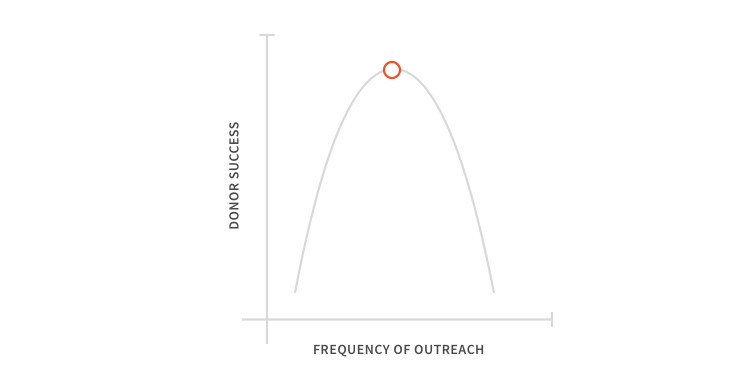
Take the example of your organization’s development or fundraising team. When coming up with a strategy for contributions they must make a determination on how often they will communicate with a given prospective donor via digital channels. Too little outreach and they won’t know anything about your organization. Too much outreach and they’ll unsubscribe, unfollow, and cancel their monthly gift. Finding the sweet spot is key.

A graph showing donor success on the y-axis and frequency of outreach on the x-axis with a parabola graphed on it

Angular thinking (the 2×2 grid)

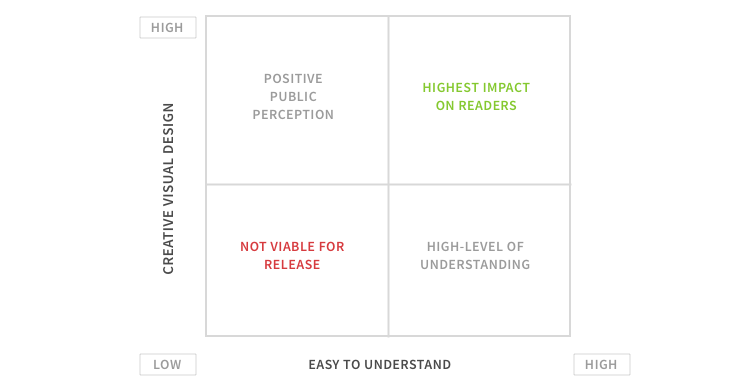
Dr. Keidel likes to joke that when two strategy consultants meet, the first question is always “What’s your matrix?” The 2×2 matrix is extremely prevalent in strategic thinking as a way to present two variables that must be balanced (or maximized) to achieve a goal.

For example, let’s say your executive director wants to redesign your annual report template this year. They meet with the design team and push them to be as creative as possible with the format to capture the attention of donors and supporters. After the meeting, the marketing team discusses their concern about users understanding the content of the report if there are too many bells and whistles. Their mandate shifts to maximize both form and function, not trading off one for the other.

A two by two matrix comparing relative levels, from low to high, of creative design and ease of understanding. The potential outcomes are Not Viable for Release in the lower left, Positive Public Perception in the upper left, High Level of Understanding in the lower right, and the best outcome is the top left - Highest Impact on Readers.

Triangular thinking (autonomy, control, and cooperation)

There are dozens if not hundreds of examples of this pattern across nearly every discipline – from nonprofit strategy to architecture to psychology to finance. 

ExampleAutonomyControlCooperation
Sports teamsBaseballFootballBasketball
Team characteristicsTalentProcessCulture
Performance measureQualityCostTime
Ways to add valueProductOperationsCustomer service

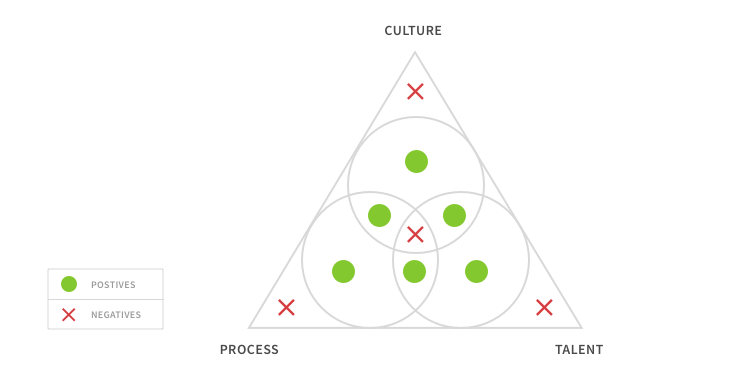
A classic example that applies to any team or organization is the balance of Talent (autonomy), Process (control), and Culture (cooperation). Talent refers to capabilities:  Do you have the right resources to build a digital strategy? Process refers to the “how” of what you do: Do you have a consistent set of steps to follow to achieve your goals? Culture refers to the connections among your team and between teams:  Can you effectively collaborate or are you simply passing tasks back and forth.

A triangle with vertices labeled talent, process, and culture. A three circle Venn diagram is within the boundaries of the shape with various points marked based on their relative viabilities as strategies.

The red Xs are important to note here.  By ending up in the center, you don’t have a true priority for your strategy. By ending up in the corners, you are “under-doing” your bottom priority. As long as you’re in a green circle, you’re in the clear!

You can place your organization in one of these positions based on your perspective. Doing so opens up a host of questions:

  • How might we add the skills or resources we need to implement our digital strategy?
  • What processes can be developed or updated to improve our work product?
  • Who should be part of planning or developing a given program or service? (Hint: You should always be talking to your audience)

Why does this matter?

It’s a fair question! These concepts are abstract and meta (thinking about thinking), but when honed and applied can be very powerful. Picking up these patterns and describing them to your colleagues and collaborators can add value to your conversations—whether you are developing a digital strategy or a strategic plan for your nonprofit. 

Next time you find yourself unsure of how to make a decision, consider whether or not you’re looking for a sweet spot (parabola), an “and” versus an “or” (2×2), or balancing three variables (triangular). If nothing else, you’ll spend less time going in circles!