Kotter’s Model: How a change management approach improves digital projects

This post was originally written in September 2019 for the Message Agency blog.

Digital projects usually seek to both decrease costs and increase efficiency through the use of technology. If the choice was “either-or,” these projects might not be as attractive to decision-makers. Most want to understand the “both-and” proposition.

John Kotter spent nearly three decades on the faculty at Harvard Business School. His 1996 book, Leading Change, was an international best seller. In 2011, TIME® magazine listed it as one of the “Top 25 Most Influential Business Management Books” of all time.

While it is most commonly taught in leadership and management contexts, I find his 8-step process for managing change to be invaluable for managing projects with our clients. To paraphrase Kotter on the topic, there are two fundamental goals at the heart of most digital projects:

  1. Increase revenue / equity or decrease costs
  2. Become more effective / efficient

Many astute managers would ask the question:  Why not both? Digital projects, in particular, usually seek to both decrease costs and increase efficiency through the use of technology. If the choice was “either-or,” these projects might not be as attractive to decision-makers. Most want to understand the “both-and” proposition.

Fortunately, by following some of the key steps in Kotter’s eponymous model, you can manage costs and increase the effectiveness of your digital project.  Achieving this goal is particularly important for nonprofit organizations and others with limited budgets, who need to ensure a substantial return on their organizations’ investments.

Urgency, Urgency, Urgency!

Like the famous rallying cry of real estate agents everywhere regarding location, the one thing your project simply can’t do without is Urgency. The unfortunate reality is that some projects will fail for one reason or another. You’ve probably been part of projects that got off the ground but couldn’t stay the course. Or maybe one decision maker’s flavor of the week replaced a more sustained effort from years past.

Regardless of the context you find yourself in when embarking on a new digital project, it is imperative that you find a source of urgency. This can come in many forms, including:

  • Executive sponsorship and support (e.g., your new ED recognizes a need to improve the website);
  • Alignment with a key milestone (e.g., your organization is celebrating its 50th year in operation);
  • Acknowledgement of the danger in maintaining the status quo (e.g., your website is end-of-life next year, and you need to raise funds for a redesign). 

Wherever you find your sense of urgency, Kotter recommends that you should do what you can to protect it!  We agree, as 50% of transformations fail at this first crucial step. Maintaining a sense of urgency means your project will be more likely to get prioritized by you and your colleagues.

Great Guiding Coalition

Your project team is another major variable in the success of your new digital strategy, website, or public education campaign. While you need dedicated resources to manage the day-to-day of your project, you also need to go beyond the usual suspects in order to ensure success. 

A great guiding coalition will include:

  • Diversity in diverse forms (e.g., level, tenure, ideas, and departments);
  • A strong project manager to consolidate communication; and
  • Accountability to the project goals.

Accountability in this case goes beyond attending meetings and checking boxes. The project team should have the goals aligned with their own department or functional goals. Digital projects can often be considered “internal work,” but should be prioritized in the same way as serving end users. 

Generating Quick Wins

During project planning, it is imperative that milestones are agreed upon early. At the same time, coalition members should be asking:  “What can we show (or implement) at the end of each phase?” This evidence of change could be as simple as a list of actions taken, lessons learned, or an immediate process improvement. Quick wins build credibility and generate support for the digital project across relevant teams. 

For example, if your user research uncovers that most donors are donating online, but you don’t have a link to donate on your homepage, could you simply add a donate button today? If so, you can address a specific, evidence-based need and demonstrate to colleagues that you are focused on tangible outcomes.  

Sustain Acceleration, Institute Change

Your coalition is collaborating at a high level. You’ve maintained your sense of urgency along the way. The quick wins are piling up, and your digital project has become the envy of the office. So, you’re good right?

Not yet.

During the project, you’ve surely bumped up against a few barriers, or found elements of your internal processes to be restrictive. Now is your chance to consider how they might be improved. Use your success so far to address a new goal that fits the overall project vision. 

For example, in creating a content strategy to drive more volunteer sign-ups through your site, you realize the intake form is not very user-friendly. To maximize the effectiveness of your website redesign, work with your volunteer coordinator to make improvements that can launch with the new site. 

Getting the additional input from their department while making an update that improves user experience is a win-win. As you build momentum in your digital project, don’t overlook opportunities to fuel further positive change. 

On the path to digital transformation

Kotter’s model can be applied to any change management process, but it is especially helpful for digital projects, where multiple stakeholders, complex technologies, and competing interests can quickly hamper progress. Change is always challenging, but if you follow some of these simple steps to help build trust and maintain momentum, it doesn’t need to be painful. 
Using geometry to build better strategies

This post was originally written in November 2019 for the Message Agency blog.

For nearly three decades, consultant Dr. Robert W. Keidel has been asking his Fortune 500 clients somewhat of an odd question: “Is your team playing baseball, football, or basketball?”

Dr. Keidel’s research revolves around strategies for organizations and how employees work together. These patterns are aligned to geometry—parabolas, coordinate planes, and triangles—to visually communicate with a great deal of efficacy. In the sports team question, he reveals a triangle that balances autonomy (baseball), control (football), and cooperation (basketball). Complex organizations will have different “games” being played on different teams and at different levels of the hierarchy, but understanding which is which can frame challenges and opportunities in a new way. 

Since our clients are almost exclusively pursuing digital strategy and digital impact in nonprofit organizations, they can benefit from using these patterns in their organization, whether it’s a foundation, a university, or a small direct service provider. 

How can these patterns help your team become better strategists? 

  • You can create very powerful visuals that communicate effectively
  • Aid colleagues in thinking more strategically about projects
  • Help unearth other patterns in your work more organically every day

The geometries of strategy

There are several different patterns Dr. Keidel uses to describe teams and strategies. We’ll focus on three in this post to get you started. 

Curvilinear thinking (parabola)

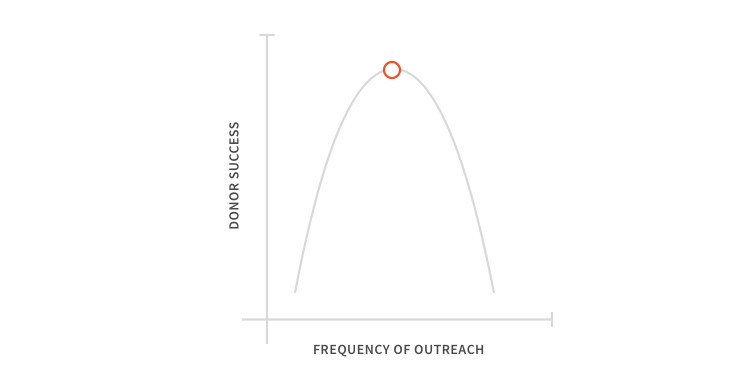
Take the example of your organization’s development or fundraising team. When coming up with a strategy for contributions they must make a determination on how often they will communicate with a given prospective donor via digital channels. Too little outreach and they won’t know anything about your organization. Too much outreach and they’ll unsubscribe, unfollow, and cancel their monthly gift. Finding the sweet spot is key.

A graph showing donor success on the y-axis and frequency of outreach on the x-axis with a parabola graphed on it

Angular thinking (the 2×2 grid)

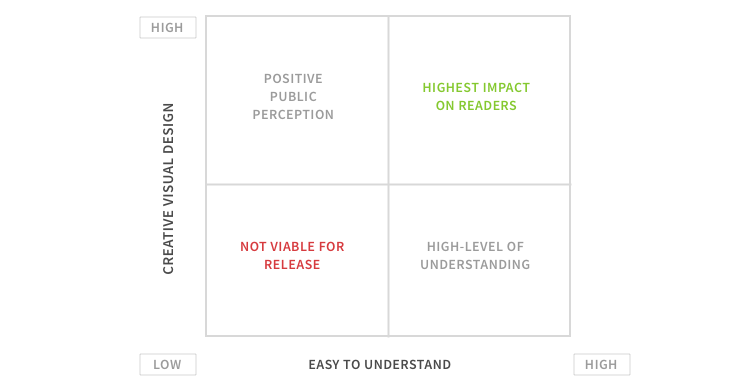
Dr. Keidel likes to joke that when two strategy consultants meet, the first question is always “What’s your matrix?” The 2×2 matrix is extremely prevalent in strategic thinking as a way to present two variables that must be balanced (or maximized) to achieve a goal.

For example, let’s say your executive director wants to redesign your annual report template this year. They meet with the design team and push them to be as creative as possible with the format to capture the attention of donors and supporters. After the meeting, the marketing team discusses their concern about users understanding the content of the report if there are too many bells and whistles. Their mandate shifts to maximize both form and function, not trading off one for the other.

A two by two matrix comparing relative levels, from low to high, of creative design and ease of understanding. The potential outcomes are Not Viable for Release in the lower left, Positive Public Perception in the upper left, High Level of Understanding in the lower right, and the best outcome is the top left - Highest Impact on Readers.

Triangular thinking (autonomy, control, and cooperation)

There are dozens if not hundreds of examples of this pattern across nearly every discipline – from nonprofit strategy to architecture to psychology to finance. 

ExampleAutonomyControlCooperation
Sports teamsBaseballFootballBasketball
Team characteristicsTalentProcessCulture
Performance measureQualityCostTime
Ways to add valueProductOperationsCustomer service

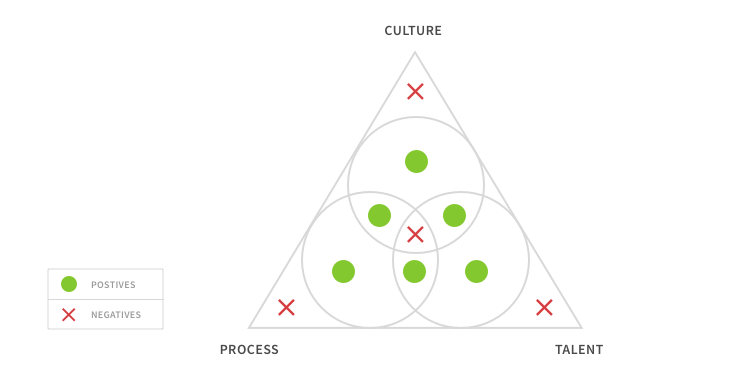
A classic example that applies to any team or organization is the balance of Talent (autonomy), Process (control), and Culture (cooperation). Talent refers to capabilities:  Do you have the right resources to build a digital strategy? Process refers to the “how” of what you do: Do you have a consistent set of steps to follow to achieve your goals? Culture refers to the connections among your team and between teams:  Can you effectively collaborate or are you simply passing tasks back and forth.

A triangle with vertices labeled talent, process, and culture. A three circle Venn diagram is within the boundaries of the shape with various points marked based on their relative viabilities as strategies.

The red Xs are important to note here.  By ending up in the center, you don’t have a true priority for your strategy. By ending up in the corners, you are “under-doing” your bottom priority. As long as you’re in a green circle, you’re in the clear!

You can place your organization in one of these positions based on your perspective. Doing so opens up a host of questions:

  • How might we add the skills or resources we need to implement our digital strategy?
  • What processes can be developed or updated to improve our work product?
  • Who should be part of planning or developing a given program or service? (Hint: You should always be talking to your audience)

Why does this matter?

It’s a fair question! These concepts are abstract and meta (thinking about thinking), but when honed and applied can be very powerful. Picking up these patterns and describing them to your colleagues and collaborators can add value to your conversations—whether you are developing a digital strategy or a strategic plan for your nonprofit. 

Next time you find yourself unsure of how to make a decision, consider whether or not you’re looking for a sweet spot (parabola), an “and” versus an “or” (2×2), or balancing three variables (triangular). If nothing else, you’ll spend less time going in circles!

Restructuring business taxes in Philadelphia

This memo was drafted in April 2019 for informational purposes for the City of Philadelphia Department of Commerce. It does not  in any way represent the Department of Commerce’s opinion or policy on this matter. 

Introduction

Philadelphia is the only one of the thirty largest cities in America to collect both a net income and a gross receipts tax on businesses. This leads to the City imposing some of the highest business tax rates in the country. According to a recent Pew Charitable Trust report, Philly also leads the way in the number of Exemptions and Incentives to lower these same taxes. The end result is a complex set of programs that compete for attention and applications from the cities’ stock of firms. While Philly may not benefit from lowering taxes to the lowest allowable level, a restructuring of tax policy to target harder to move assets and a simplified set of taxes could allow for similar revenue collection and lessen the burden on businesses. 

What is the current state of business tax in Philly?

Pew reviewed five cities who collect only Gross Receipts tax – one element of BIRT in Philadelphia. These cities – Los Angeles; Memphis, TN; Nashville, TN; Seattle; and San Francisco – tax all of the money a business collects regardless of their profitability. Philadelphia’s rate is actually lower than all five of these cities – currently 0.1451% on all businesses regardless of size. Tennessee is a bit of a unique case as the state collects the gross receipt tax and remits to the cities. San Francisco has one static rate slightly above Philadelphia’s (SF charges 0.1625%). Both Seattle and Los Angeles have a bracketed approach to the Gross Receipts tax. Both Seattle (charges 0.150% to 0.415%) and LA (charges 0.101% to 0.507%) differentiate their tax rate by industry classification.

What would a Gross-Receipts-only model look like in Philly?

If the City were to take a similar route in their tax policy, it is possible that the city could lower taxes on certain classes of businesses while scaling up the rate to those firms who generate the most revenue in the city. If Philadelphia were to triple the current rate for those industries it deems appropriate, it would still be lower than the high-end tax rate in Los Angeles (0.4353% in Philly vs. 0.507% in LA). If one were to triple the tax revenue associated with Gross Receipts in 2016, that would mean $240 Million in revenue. This would still leave the city short in the short-term, though the simplification of the tax code and lowering of overall tax burden should make Philadelphia more attractive to expanding or relocating firms. 

What other goals should be set for Philly’s business tax policy?

In general, Philadelphia should be focused more on taxing revenue sources that are not as mobile as net income or gross receipts. In 2018, the U.S. Supreme Court ruled on Wayfair v. South Dakota, which related to the collection of sales (and use) taxes by firms, despite not having any physical presence in a state. This ruling takes away some of the “mobility” previously available to Gross Receipts tax incidence. Another policy avenue available to other cities, but not cities in Pennsylvania, is a differentiated property tax rate for commercial properties. Due to the uniformity clause in the State Constitution, Philly does not have access to the potentially potent tool. 

Conclusion

In conclusion, Philadelphia has policy tools available to it if the city wants to be more business-friendly, if not as many as other cities. Our number and type of tax policies create confusion and discourage businesses from complying with our rules. Our relatively low rate of Gross Receipt tax leaves room for the city to expand this piece of the revenue pie in line with other large cities. A general policy of moving to a simplified system which taxes revenue sources that are harder to move – like real estate, gross receipts, etc. – would make for a more stable revenue stream and limit opportunities for firms to reduce their tax burden artificially. 

Regulating Philadelphia’s Gig Economy

This memo was drafted in June 2019 for informational purposes for the City of Philadelphia Department of Commerce. It does not  in any way represent the Department of Commerce’s opinion or policy on this matter. 

Executive Summary

Despite huge growth over the last eight years, the gig economy is a controversial subject with supporters and detractors across the country. Those in favor say it provides flexibility and scalability for talented workers to earn income on their own schedule. Those opposed see greedy corporations placing the risk on employees while withholding some of the reward they’d receive if they were truly “independent.” Philadelphia is home to many thousands of gig economy workers, and faces a difficult challenge in balancing reform and protections for workers with preserving this vital source of income for non-traditional employees. By working closely with employee rights’ groups and freelancers of all shapes and sizes, new incentives and penalties should be developed to better manage the gig economy labor market, as opposed to banning it outright. 

What is the Gig Economy? How does it interact with the larger labor market?

The gig economy is a term used to describe a wide variety of temporary, part-time, flexible labor contracts, which can have varying degrees of complexity. For example, adjunct professors or high-skilled freelance workers are just as much gig economy members as Uber drivers and Rover dog walkers. When viewed in this more holistic way, as much as one third of Americans already have a “gig” as part of their professional life. Workers choose gigs because of the flexibility and, in some cases, to get into a new job or back to work quickly without dealing with traditional hiring processes. 

Employers also benefit in many ways from the arrangements possible in the gig economy. For example, an employer who cannot afford to continue hiring full-time employees as they scale may use gig economy workers to fill in the gaps. Another way the employer may benefit is by expanding their available talent pool. A graphic designer, for example, may not be able to move across the country to design them a logo full-time, but would gladly contract with the firm remotely using technology as a bridge. Both parties benefit a great deal in this scenario – the freelancer gets a client and the organization gets a cost effective brand identity.

What is the Gig Economy’s impact on Philadelphia?

According to a Brookings Institute report, two major elements of what most consider the gig economy – ride sharing and room sharing – are growing in Philadelphia. From 2012 to 2014, ride-sharing work grew by 6% and rooms grew by 2%. From the report: “The spread of nonemployer firms between 2010 and 2014 occurred mostly in the largest metro areas. No less than 81 percent of the four-year net growth in nonemployer firms in the rides sector took place in the 25 largest metros, while 92 percent occurred in the largest 50 metros.” Despite being significant and growing quickly, the report makes it clear that app-based employment is not displacing payroll employment. 

This data is a combination of Census Bureau’s survey measuring Nonemployer Businesses by census tract and corresponding NAICS codes – meaning with some minor manipulation, it would be easy to monitor long-term. Collection and reporting of this data should accompany any initial meetings internally, and can also be leveraged to plan an effective hearing should one be called (i.e. inviting appropriate industry representation, not just Uber). 

What does the California case study demonstrate?

In April 2018, the California Supreme Court ruled “that employers must treat workers who do work related to a company’s ‘usual course of business’ as full-fledged employees.” As an example of the standard, a plumber hired to fix a sink at a business would not be considered an employee. However, if a clothing company hired a worker to sew at their home, they would be entitled to a minimum wage, breaks, and other employment benefits. This ruling only applied to a shipping firm called Dynamex, but set a precedent that could impact many types of workers in California, including care givers, dog walkers, hair stylists, and ride-share drivers. It would make gig work illegal in the current state it exists, and require companies to take on significant costs and risks, including minimum wages, additional payroll taxes, and benefit contributions. An MIT professor estimated an increased cost per employee of between 25% to 40%.  

In May 2019, following protests by Uber drivers related to the company’s forthcoming IPO, California lawmakers passed legislation which provided stricter guidelines for worker classification. For workers to be classified as independent contractors, companies will have to prove the following three conditions: 

  1. That they don’t control or direct the person’s work
  2. That the worker’s services aren’t related to the company’s main business 
  3. And that the person is engaged in an “independently established trade, occupation, or business of the same nature” as the work performed.

These conditions would almost certainly make many popular app-based gigs classifiable as full-time employment. Examples include Lyft, Uber, AmazonFlex, GrubHub, Postmates, Care.com, and Wag. The bill seems to get these workers closer to their demands from the protests – mainly better wages, job security, and better treatment from their corporate higher-ups. It’s important to note that the demands vary from place to place depending on the local issues. 

What should regulatory goals should Philadelphia pursue?

Gig economy work can be very important and meaningful in the life of Philadelphia’s residents. There are certainly drawbacks as evidenced in the California case study – companies are effectively transferring the burden from themselves to the employee who bears much more of the risk than traditional workers. Legislation like that in CA will completely turn the tables and put the burden back on employers. However, a very basic economics model of supply and demand tells us that as the cost of these workers increases, the demand for their work will decrease as well. Large, well-funded organizations will be able to weather this storm, but small and medium-size businesses will be hit the hardest by these new regulations. 

Philadelphia should be cautious in how they regulate this transfer of burden from employee to employer, as we could lose critical, low-skill and low-barrier-to-entry jobs for vulnerable residents. According to a 2018 survey by UpWork, an online freelance marketplace, 42% of freelancers said they like gig economy arrangements because they aren’t able to work for a traditional employer. Whether it be those who recently lost jobs, have family obligations, or other hurdles to traditional employment, the gig economy provides an opportunity to be productive and earn income with little commitment or training. Another finding from their survey showed that gig economy work is valued by those who are of retirement age or older for all of the same reasons mentioned above. It would be more harmful than good if Philadelphia made this kind of work impossible. 

Conclusion/Recommendations

The gig economy is growing rapidly, but now finds itself on shakier ground that it did a year ago. While abuses of employee rights should be fought, outlawing a type of work arrangement will not necessarily solve the core issue. Organizations must be held accountable for treating employees fairly regardless of their size, scale, or employee base. Philadelphia should prioritize policy solutions that better manage this labor market, but not ban it outright. Some recommendations for how to proceed could include:

  • Holding a hearing that includes a wide variety of gig workers – not just ride-sharing, but adjunct professors, care givers, etc. – and specifically addresses how to preserve their way of working while improving their outcomes
  • Research and develop incentives for employers to provide pathways to full-time employment (for those who want it) and protections for part-time and gig economy workers
  • Host convenings of on-the-ground advocates such as the Freelancers Union, and other worker’s rights groups, to gain insight into current demands and potential solutions from around the country
  • Continue to pursue pro-worker policies such as the increased minimum wage, enforcement of worker protection laws, and social safety net programs 

An approach to marijuana legalization policy in Philadelphia

This memo was drafted in March 2019 for informational purposes for the City of Philadelphia Department of Commerce. It does not  in any way represent the Department of Commerce’s opinion or policy on this matter. 

Executive Summary

Medical marijuana is legal in thirty-three streets and the District of Columbia. Ten states and the District of Columbia have fully legal adult marijuana markets. Estimates show the United States marijuana approaching nearly $50 billion in sales annually. In PA alone, a fully legal market would be estimated at $1.66 billion annually, with tax revenues of roughly $600 million. The industry would create tens of thousands of new direct and indirect jobs annually, many requiring no advanced education. Innovations in policy, such as requiring diversity in leadership of marijuana businesses, preference to disadvantaged communities, and micro licenses, help ensure inclusive growth as the industry matures. 

How many states have legalized marijuana? And to what degree?

As of March 2019, thirty-three states plus Washington D.C. have legalized marijuana for medical purposes. Another ten states plus Washington D.C. have fully legalized marijuana for adult use. Several more, including New Hampshire and New Mexico, are poised to approve legalization for adult use. While it is currently an illegal drug under federal law, recent reports suggest that Congress could soon introduce legislation for fully legalizing marijuana nationwide. More locally, New York, New Jersey, and Delaware all permit the sale of medical marijuana, and all three have also introduced legislation in the last year that, if passed, would make marijuana fully legal for adult use. New York Governor Andrew Cuomo has changed his view on legalization in recent months, in part due to fears of losing sales over the border to states such as Massachusetts or Vermont.

Current State: How have Pennsylvania and Philadelphia dealt with medical marijuana?

On April 17, 2016, the state of Pennsylvania’s Medical Marijuana Program was signed into law. It established three types of permits – Growers & Processors, Dispensaries, and Clinical Research – which allow for narrow permissions within each niche. Geographically they are spread across six regions – Philadelphia County is part of Region 1 (Southeast). Philadelphia is currently home to five Dispensaries, and zero Grower/Processor facilities. There are also five Clinical Research permits in Philadelphia, associated with some of the city’s top academic institutions: Temple University, Drexel University, University of Pennsylvania, Thomas Jefferson University, and Philadelphia College of Osteopathic Medicine.

Pennsylvania requires several Diversity and Inclusion items as part of their application for permits, which are scored to aid in decision making. In our preliminary research, there does not appear to be another state offering full adult legalization with a similar requirement for diversity and inclusion. These plans cover diversity of those hired by the organization – with a requirement of at least one diverse hire on the leadership team; Diversity in contracts – applicants must provide a percentage of contracts given to diverse contract firms; and a Community Impact Score – related to the number of jobs created, site selection, etc. These are well-intentioned incentives meant to avoid a direct transfer of wealth from the marijuana black and grey markets to a wealthy group of investors. Further policy innovations in full legal markets are addressed later in this memo.

What is the economic impact of the legalized marijuana market?

A 2015 report from the Marijuana Policy Group conducted a true input-output analysis – the best practice for measuring total impact. Their research team estimated a 2.4 multiplier for the marijuana retail industry in Colorado. In other words, for every $1.00 invested, $2.40 is generated to the economy. While this measure would need to be recalculated for Philadelphia, even a conservative estimate would place it in line with the largest economic drivers in the region. Additionally, multiplier effects from production of edible products and cultivation would be generated as well.

In July 2018, Pennsylvania Auditor General Eugene DePasquale released a report on potential economic impacts of marijuana legalization in the state. Using the average adult consumption from Colorado and Washington state as the basis, his office estimates a $1.66 billion sector, leading to approximately $581 million in annual tax revenue. This does not include any additional revenues gained through payroll taxes, indirect employment, or marijuana tourism. Studies have also shown that adult use actually increased by about one-third over the first three years of legalization, while underage use falls due to limited black and grey market sales. 

How many and what kind of jobs would be created?

A recent survey by cannabis-specific recruiting firm, Vangst, shows a 690% growth in cannabis job listings between January 2017 and August 2018. Roles tracked in the survey include the full range of experience and salary levels relevant to the industry. As an example, Budtenders and Trimmers, who require the lowest level of experience, range from $11.50/hr to $16/hr. White collar work commanded a range of salaries from $45,000 on the low-end to a high of $250,000 per year. Due to significant competition for talent as the new industry blossoms, salaries measured by the survey increased 16% from 2017 to 2018. At less than half the population of Philadelphia, Colorado was able to generate over 18,000 direct and indirect jobs in 2015 alone. Examples of indirect employment created include security guards, commercial real-estate agents, construction and HVAC specialists, consulting, legal, and advisory services, and other business services.

One policy innovation being pursued in New Jersey would require a certain quantity of permits be reserved for Micro-licenses. Micro-licenses allow license holders to operate much the same way — growing, processing or selling marijuana — but at a smaller scale, which lessens the capital burden at the start. Lawmakers are also considering giving preference to license applications from areas disproportionately affected by marijuana arrests or, alternatively, to areas with high levels of unemployment. Both policies are aimed at more inclusive growth for the industry as it matures. 

Conclusions and Recommendations

In terms of public opinion and legislative results, marijuana legalization may be more popular than anytime in US history. Momentum at the local, state, and federal levels, while varying, is moving in a clear direction in favor of legal adult use. Any discussion of policy should consider both the positive and negative externalities of such a decision, including:

  • How might we address concerns about public health? While research does not show marijuana to be any more dangerous than cigarette smoke or alcohol consumption, issues such as tests for impaired driving and underage consumption must be addressed.
  • If Pennsylvania law differs from neighboring states, how might law enforcement officials coordinate to ensure successful policing of residents? 
  • How might Philadelphia build on the state’s efforts to create an inclusive marijuana industry? 

The best time to invest in education was 50 years ago, second best time is now

This memo was drafted in March 2019 for informational purposes for the City of Philadelphia Department of Commerce. It does not  in any way represent the Department of Commerce’s opinion or policy on this matter. 

Executive Summary

  • Relatively modest gains in educational quality lead to significant economic multiplier effects in the long-run – a modest improvement yields an additional $1 trillion in GDP over the status quo scenario
  • Student achievement is found to be closely linked with teacher quality, but other factors such as a healthy and productive environment are prerequisite
  • Reforms to education policy take time to implement, with benefits deferred for at least 10 years in terms of school quality improvement. 
  • Improvements in the labor force and broader economy peak after 50 years (10 years of reform followed by 40 years of retirement/replacement rate), however benefits are compounded over time as the average education level rises. 
  • Educational improvement is an incredibly powerful driver of economic output, but due to the deferred nature of results, cannot be the only driver of growth for a modern economy.

Does educational improvement lead to better economic outcomes?

Relatively modest gains in educational quality lead to significant multiplier effects in the long-run. It has been estimated that 13% of the growth rate of U.S. national income between 1929 and 1982 was caused by increases in the level of education obtained by U.S. residents. A commonly accepted baseline for expected GDP growth, under current education policy, is projected to be 1.5% per year by the Congressional Budget Office.

By improving Pennsylvania’s position within national rankings by only ¼ of a standard deviation over ten years, Pennsylvania and Philadelphia could see massive impact on the growth of the economy. This improvement would be the equivalent of going from the last ranked state (50th) in the country to 41st in the rankings, or from 8th best state to becoming the top ranked state (based on 2015 data). As a point of reference, Pennsylvania is 15th in terms of 8th Grade Mathematics in the 2017 rankings (via NAEP). This improvement was chosen by the authors of the study we reviewed as the authors observed at least 14 states that made a similar sized improvement over the last two decades. 

Making this modest improvement over a ten-year period in Pennsylvania would improve our expected annual growth rate from 1.5% to 5.6%. Based on Pennsylvania’s 2017 GDP of $531.1 billion, that 5.6% annual increase means adding just shy of $30 billion to the economy in an average post-reform year. When added together over the career of a student cohort (in this case estimated at 80 years), the return on this modest improvement is 2.6 times state GDP, or over $1 trillion more than the current education policy scenario.

One way to accelerate the compound benefit over time is starting with early interventions such as Pre-K programs. A study from the Pennsylvania Department of Education showed investments in quality pre-k programming return approximately $7 for every taxpayer dollar invested. And when the benefits of increased tax revenue are combined with reduced welfare spending, investment in quality pre-kindergarten programs return up to $17 for every dollar spent. Additionally, helping students be more productive early in their education will lead to compounded benefits over the life of their cohort. As shown in Figure 2 below, there is exponential return on earlier investment as improvements compound over time. 

What is the timeline for impact measurement of education policy reform?

Education policy reform is not instantaneous. One study projected improvements over a ten-year period, assuming linear growth among students that yielded the full benefit at the end of year ten. Another suggested that improving the quality of the average teacher is best achieved through hiring and retention or dismissal policies, as in-service trainings and other interventions have not been as effective. They provided an analysis assuming a 7% turnover rate combined with the average new teacher hire averaging performance in the 56th percentile, which led to significant improvement after 20 years of implementation. If the turnover rate is increased to 14% through changes in policy or perception of the profession, significant student improvement can be obtained in ten years.

This improvement is different from the improvement in the labor force, which can only improve as less educated workers retire and more educated workers begin their careers. Estimating a 2.5% retirement and replacement rate for more educated students, implying the ultimate quality of the labor force is achieved over 50 years (10 years of reform followed by 40 years of retirements).

How might we measure, and improve, school quality?

For the purposes of this memo, when quality is referenced, it is specifically defined as scores on standardized tests in mathematics and science administered by IEA (International Association for the Evaluation of Educational Achievement), an international cooperative of national research institutions, government research agencies, scholars and analysts working to evaluate, understand and improve education worldwide. Research using this data and including factors such as school resources and externalities (parental involvement, for example), showed significant differences in economic impact.

There is a lack of any consistent or systemic effect of resources on student achievement or school quality. That is not to say resources are irrelevant. In many urban school districts, such as Philadelphia, resource levels and quality of environment can vary drastically from school to school. If dangerous and unhealthy conditions exist, improvement will be hampered regardless of quality or quantity of other inputs. In these cases, whether by increasing resources or simply reallocating existing spending, addressing these issues should come first. On the other hand, there clearly are situations where small classes or added resources have an impact. It is just that no good description of when and where these situations occur is available. 

By many accounts, the quality of teachers is the key element to improving student performance. But the research evidence also suggests that many of the policies aimed at improving performance that have been pursued around the world have not been very productive. This issue can be compounded by the issues mentioned above relating to school quality. If teachers are lacking the very basic resources and safe, healthy work environments expected in any career, they will likely be less effective and/or consider leaving the school, district, or even the profession should issues persist.

According to Eric Hanushek, who has done extensive research in this area, the most feasible approach to improve teacher quality is to experiment with alternative incentive schemes. These might involve new contracts and approaches to teacher compensation, introduction of parental choice across schools, merit awards for schools, etc. The unifying theme is that each should be designed to improve student achievement directly. For example, merit awards to teachers would be directly linked to objective information about student performance. While this may be very challenging to implement in the short-term, many cities have taken up the mantel and are moving towards invaluable reform (Hanushek, et al Economic Outcomes).

What have other cities done to reform their schools? Is there a model for Philadelphia to emulate?

Boston, Chicago, Cincinnati, Minneapolis, and New York City are all examples of districts that have adopted rigorous content and performance standards and have aligned the curricula, instruction, and other aspects of their systems to those standards. They have used data, including comprehensive student information management systems, to guide their decisions and have emphasized professional development for teachers and principals. They have relied on frequent formative assessments. They have also developed a culture of learning and collaboration among teachers. But districts have taken very different routes even to making these sorts of changes—and these differences reflect marked differences in their circumstances.

Urban school districts, which frequently have high concentrations of students at risk for school failure, are at the forefront in the challenge of defining and ensuring equity, and many have also been pioneers in school reform. Low levels of achievement, struggles to recruit and retain both effective teachers and administrators, and the needs of families in high-poverty neighborhoods are among the challenges that face these districts. In short, the literature on district reform suggests that a district can be a strong agent for reform and that districts that have achieved improvements share several attributes:

  • a systemwide approach in which policies and practices are aligned;
  • strong support and professional development for both teachers and administrators;
  • clearly defined expectations for students and teachers, combined with a strong emphasis on improvement; and
  • reliance on data to support instructional decisions and for accountability.

Conclusion / Recommendations

Improving school quality will lead to significant economic impact on the city of Philadelphia. Specifically, this type of growth would be inclusive, assuming consistent policy applied to the School District of Philadelphia. Educational advance can contribute directly and indirectly to economic growth. In direct cases, by increasing the human capital and thus the productivity of the workforce. In the indirect, by increasing the rate of innovation and adoption of new technologies. Both are central to Philadelphia’s future as a world-class city.

When considering the deferred benefit timeline, education alone cannot drive our economy. Philadelphia must continue to spur business activity through proven policy measures until the multiplier of education is reached. Philadelphia would also benefit from the continued attraction of talented individuals and firms from outside the city and region.

Sources:

Golden, Claudia, and Lawrence Katz. “The Legacy of U.S. Educational Leadership: Notes on Distribution and Economic Growth in the Twentieth Century.” Scholar.harvard.edu, National Bureau of Economic Research, 2018.

Hanushek, Eric A. Economic Outcomes and School Quality. International Institute for Educational Planning, 2005.

Hanushek, Eric, et al. “Economic Gains for U.S. States from Educational Reform.” NATIONAL BUREAU OF ECONOMIC RESEARCH, 2015, doi:10.3386/w21770.

Hanushek, E. A., & Kimko, D.D. (2000). Schooling, labor force quality, and the growth of nations. American Economic Review, 90(5), 1184-1208.

Hungerford, Thomas L, and Robert W Wassmer. K-12 Education in the U.S. Economy. National Education Association, 2004, pp. 1–48, K-12 Education in the U.S. Economy.

Mitra, Dana. Pennsylvania’s Best Investment: The Social and Economic Benefits of Public Education. Education Law Center, 2011, pp. 3–31, Pennsylvania’s Best Investment: The Social and Economic Benefits of Public Education.

NAEP. “NAEP Report Cards – Home.” The Nation’s Report Card, 2017, http://www.nationsreportcard.gov/.

National Academies Press. A Plan for Evaluating the District of Columbia’s Public Schools: From Impressions to Evidence. National Academies Press, 2011.

How a Business Acceleration Team can help Philly’s business community

This memo was drafted in September 2019 for informational purposes for the City of Philadelphia Department of Commerce. It does not  in any way represent the Department of Commerce’s opinion or policy on this matter. 

What is the current state of the business customer experience in Philadelphia?

Opening a new business in Philadelphia, like in all major cities, involves a series of permits, inspections, and associated paperwork and processes to obtain them. Through the Food Business Process Improvement Pilot which included both internal (city staff) and external (business owner) design thinking workshops, the City was able to map the process, identify pain points, and recommend process improvements. Commerce learned that the process is complex, difficult to navigate, and overall challenging, especially for small business owners. Drivers of some issues with Cx include: 

  • No central office with all of customer’s data available to them
  • Data sharing among departments is ad hoc and inconsistent – anecdotally we’ve heard it can often take two weeks to complete some data requests
  • Performance metrics for these departments are not aligned to the goals of the customer experience
  • Process improvement is not baked into the current process due to departmental silos
  • No one owns the overall business Cx, and this lack of ownership means lack of accountability as well

How has New York’s model for a BAT worked?

The New Business Acceleration Team (NBAT) was developed by New York City under Mayor Bloomberg’s administration to make it easier for small businesses to work with the city. Given the number, varying size, and number of permits and licenses required, restaurants were an obvious fit. Initially the model was meant to crack down on the number of violations that occurred, but quickly pivoted to helping better serve these establishments. 

NBAT consisted of representatives from all major departments interacting with these businesses including Health Department, Department of Buildings, Fire Department, and Environmental Protection. One of the key tasks this group completed was a process map, laying out all of the steps, stakeholders, and pain points for a restaurant to open in New York. Members of the team reported both to NBAT and to their own department, and mostly relied on existing administrative systems to communicate and share information on individual businesses. A small-scale Salesforce instance was later deployed, though an enterprise-level solution was not successfully adopted. 

NBAT assigns a client manager to each business, with managers having approximately 75 clients each at varying stages of their projects. Their main responsibility was to make sure inspections happened just-in-time to avoid costly delays in opening and inefficient use of city resources. Cross-trained inspectors were used to help consistently and completely identify issues at client sites prior to inspections, solving a major issue for businesses who didn’t know what was expected of them. 

Are there additional models to consider when developing Philly’s BAT?

In addition to the New York model, we reviewed other cities and how they’ve been able to improve Cx for businesses specifically. 

Chicago, Small Business Center

City of Chicago launched an in-person, one-stop-shop for business needs related to permits, licenses, and inspections. Department representatives from each of the main stakeholder groups sat together in this new center. All necessary forms and paperwork were in one place, with consultants able to help guide business owners through the process. This helped cut down on avoidable paperwork errors, and advise businesses on inspection expectations to help them pass on the first try.

Chicago, Business District 

An online system, which is connected to the user’s business account with the city, Chicago Business District allows businesses and their legal teams in Chicago to complete most of their transactions with the city remotely. The system operates through manual review and approval of the information for zoning or licenses, and integrates with the city’s larger business and tax database (IRIS) to facilitate updates and processing of tax information. 

Los Angeles, LADBS Go App

The City of Los Angeles offers online tools in addition to a mobile application called LADBS Go. This is an Android and Apple application allowing business owners of any size or type to use their same city log-in to schedule inspections, check status of permits, view wait times for various service counters, and report violations they see elsewhere in the city. 

Austin, Smart Start

In collaboration with a locally-based technology firm, the city of Austin, Texas now offers Smart Start on their website. Essentially, Smart Start services as a comment thread on their checklist pages of how to get started doing business in the city. Joint review and answering of questions is managed by the city’s Development Services (most similar to L&I in Philly) and Economic Development departments. 

Which model would be ideal? And which would be most feasible in Philadelphia? 

In lieu of recommending a particular model, there are a few aspects of each approach that should be kept at the center of any discussion of improved business customer experience in Philadelphia. Each of the cities we studied solved a few key problems for both businesses and themselves.

  1. Map the current process. This is an invaluable first step to explore, understand, and document the environment as it exists currently.
  2. Establish a performance baseline. Performance metrics must be developed and agreed upon, along with a plan to accurately measure and regularly report on each one. For example, should the city prioritize time to completion of permits? Or ratio of approvals or inspections passed?
  3. Build a process for continuous improvement. While information sharing and concierge-type services are helpful, ultimate success lies in empowering front-line staff to contribute process improvements as they arise.
  4. Assign ownership of these metrics to a team or executive. Without support and management toward improvement of these metrics, no model will be successful.

What made the New York model so impressive was their understanding of the problem: business owners were losing money, and thus the city was losing tax revenue. This created the urgency needed to get all stakeholders on the bus and moving towards their shared goal, a faster approval process for restaurants in the city. Whether or not case managers are involved, they keyed in a few areas to save time and resources, such as consulting business owners on expectations for their inspections and ensuring those inspections happened just-in-time. 

It would be valuable to learn more about the problems Los Angeles and Chicago had set out to solve initially before we can determine the relative value of their models. Chicago chose a more human capital intensive program, with physical presence playing a key role. LA services much of their business transactions through web and mobile applications, which have higher start-up costs, but can be lower cost options in that they scale most efficiently. In an ideal scenario, a balanced approach would be deployed to best serve the most with the least resources required.